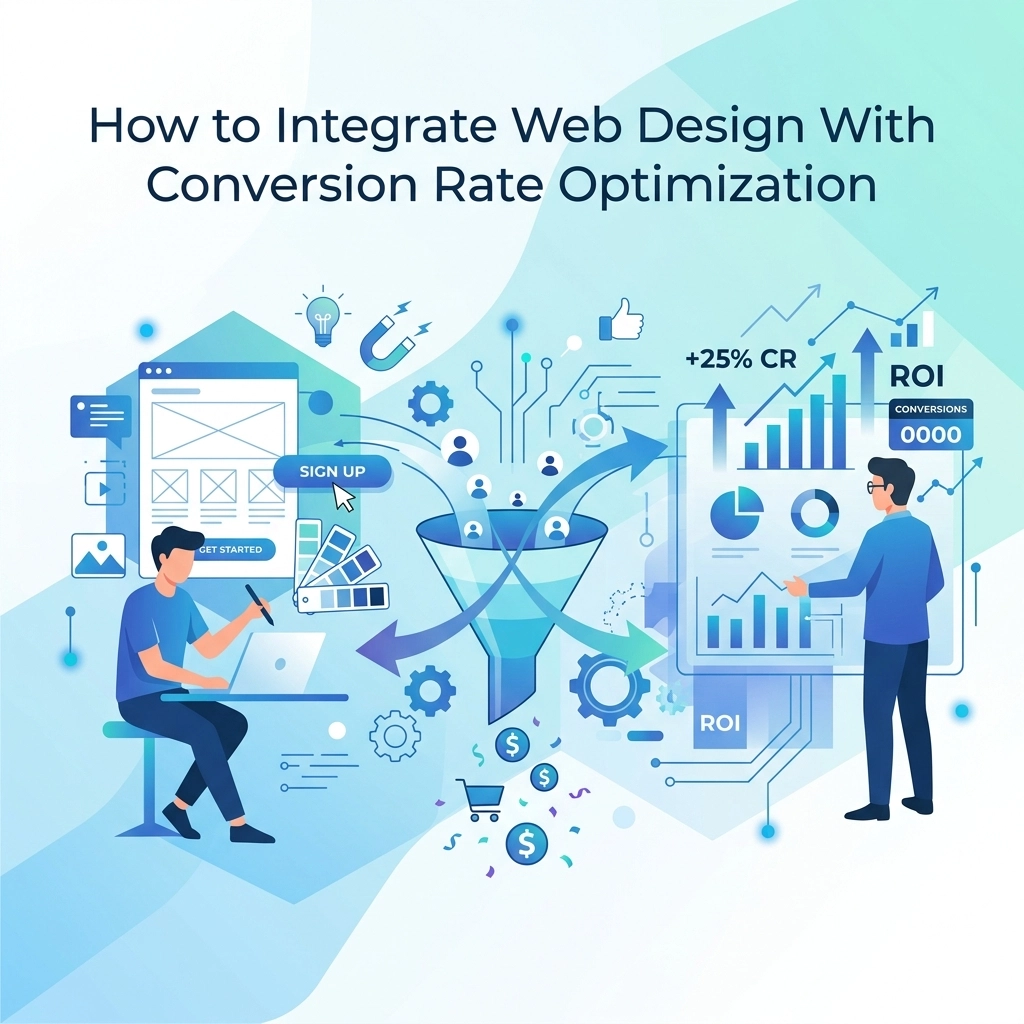

A website that looks good but fails to generate leads is a failed business tool. Many businesses focus on aesthetics while ignoring how users actually behave. This creates a gap between a beautiful layout and a profitable one. You need to bridge this gap by integrating web design with Conversion Rate Optimization (CRO).
CRO is the systematic process of increasing the percentage of website visitors who take a specific action. This could be filling out a contact form or making a purchase. When you align your design decisions with these goals you turn your website into a high-performance sales engine
Focus on Visual Hierarchy to Direct Attention
Visual hierarchy is the arrangement of elements in a way that implies importance. Without it visitors feel overwhelmed and leave. You must guide the user's eyes to the most important parts of your page
The problem is that most sites clutter the layout with too many competing elements. The solution is to use size, color, and whitespace to create a clear path. Your headline should be the largest text on the page. Your Call to Action (CTA) button should use a high-contrast color that stands out from the background. By using white space effectively you allow these key elements to breathe and attract more clicks

We recommend using the "F-Pattern" for text-heavy pages and the "Z-Pattern" for landing pages with less content. Humans naturally scan web pages in these shapes. Placing your most critical information along these paths ensures it gets seen. If you need help structuring your layout you can view our strategy services to see how we plan high-converting sites
Simplify Navigation to Reduce Friction
Complex navigation kills conversions. If a visitor cannot find what they need within three clicks they will likely abandon your site. Many businesses try to show off every service at once which causes "choice paralysis"
You should streamline your menu to include only the most essential categories. Use clear and descriptive labels instead of clever or vague ones. For example use "Our Services" instead of "What We Do Better Than Anyone Else"
A simple navigation bar reduces the cognitive load on the user. This makes it easier for them to move through the sales funnel. For complex sites consider a "mega menu" that remains organized or a robust search feature. You can explore how we handle complex site structures on our web design page
Place the Value Proposition Above the Fold
The "fold" is the portion of the website visible without scrolling. Research shows that users spend 80% of their time looking at information above the fold. If your value proposition is hidden at the bottom of the page you are losing money
Your value proposition should answer three questions immediately:
- What do you offer?
- Who is it for?
- Why should they choose you?
The design should support this message with a bold headline and a supporting sub-headline. Use a hero image that reinforces the emotional benefit of your service. Avoid generic stock photos that look fake. Use high-quality original photography that shows your product or team in action. This builds immediate trust and encourages the user to keep scrolling

Optimizing Calls to Action for Maximum Clicks
A Call to Action (CTA) is the most important design element for CRO. If your buttons are small or blend into the background nobody will click them. Many sites make the mistake of using "Submit" or "Click Here" as button text
You should use action-oriented language that tells the user exactly what they get. Instead of "Submit" use "Get My Free Quote" or "Download the Guide Now." The design of the button matters as much as the text. Use rounded corners to make them look clickable and ensure there is enough padding around the text to make it readable
Place CTAs strategically throughout the page. You should have one above the fold and another at the end of each major section. This gives the user an opportunity to convert as soon as they are convinced by your content. For more insights on building effective CTAs check out our marketing page
Leverage Color Psychology and Contrast
Colors trigger emotional responses. If your site uses colors that clash or fail to represent your brand tone you will push users away. For instance blue is often associated with trust and security which is why many financial institutions use it. Green is associated with growth and health
The "Isolation Effect" states that an item that stands out like a sore thumb is more likely to be remembered. In web design this means your CTA should be a color that is not used anywhere else on the page. If your brand colors are blue and white an orange or lime green button will grab attention instantly

Speed and Performance are Design Features
Slow sites do not convert. If your page takes more than three seconds to load your bounce rate will skyrocket. Many designers make the mistake of adding heavy animations and unoptimized images that slow down the user experience
You requested a site that works well and performance is a key part of that. Optimize your images by compressing them without losing quality. Use modern file formats like WebP. Minimize the use of heavy scripts that block the page from rendering quickly. A fast site provides a better user experience and is rewarded by search engines. If your current site is lagging you might need better web hosting to support your traffic
Design for Mobile Users First
More than half of all web traffic now comes from mobile devices. If your site is not responsive you are alienating a massive portion of your audience. A site designed only for desktops will look broken on a phone making it impossible for users to convert
Mobile design requires larger buttons that are easy to tap with a thumb. Text must be large enough to read without zooming. Avoid using hover effects because they do not work on touch screens. Focus on a single-column layout that makes scrolling easy. You can see how we handle mobile-first projects in our portfolio

Build Trust with Social Proof and Security Signals
Users are hesitant to share their information or spend money on a site they do not trust. Design can fix this by incorporating trust signals. These include customer testimonials, case studies, and industry certifications
Place testimonials near your CTAs to provide a final nudge. Use logos of well-known clients or partners to build authority. If you handle sensitive data ensure that security badges are visible during the checkout or sign-up process. Clear contact information and a professional "About Us" page also go a long way in establishing credibility. We provide more information about building a professional presence on our about page
The Role of A/B Testing in Design
You cannot guess what will convert best. You must test. A/B testing involves creating two versions of a page with one small difference: like the color of a button or the wording of a headline: and seeing which one performs better
This is where design meets data. Every design choice should be treated as a hypothesis until proven by user behavior. Testing allows you to make incremental improvements that lead to massive gains over time. We suggest starting with your highest-traffic pages to see the fastest results
Use Short Forms to Increase Completion Rates
Long forms are a major deterrent. Every additional field you add to a form decreases the likelihood that someone will finish it. If you ask for too much personal information upfront users will get suspicious and leave
Only ask for the information you absolutely need to start a conversation. You can always gather more details later. Use a clean design for your forms with clear labels and error messages that help the user fix mistakes. If you are ready to improve your lead generation you can get started with a simplified process today
Final Summary of Integration Steps
Integrating design and CRO is not a one-time task. It is a continuous process of refining the user experience. You identified a need to improve business results and the solution is a conversion-focused design
To recap your action plan:
- Use visual hierarchy to guide the user's eye
- Keep navigation simple and intuitive
- Put your value proposition front and center
- Make CTAs bold and action-oriented
- Prioritize speed and mobile responsiveness
- Build trust with social proof
- Test everything to see what works
By following these steps you ensure that your website does more than just look pretty. It becomes a functional tool that grows your business. If you need a partner to help implement these changes contact us to discuss your project further