
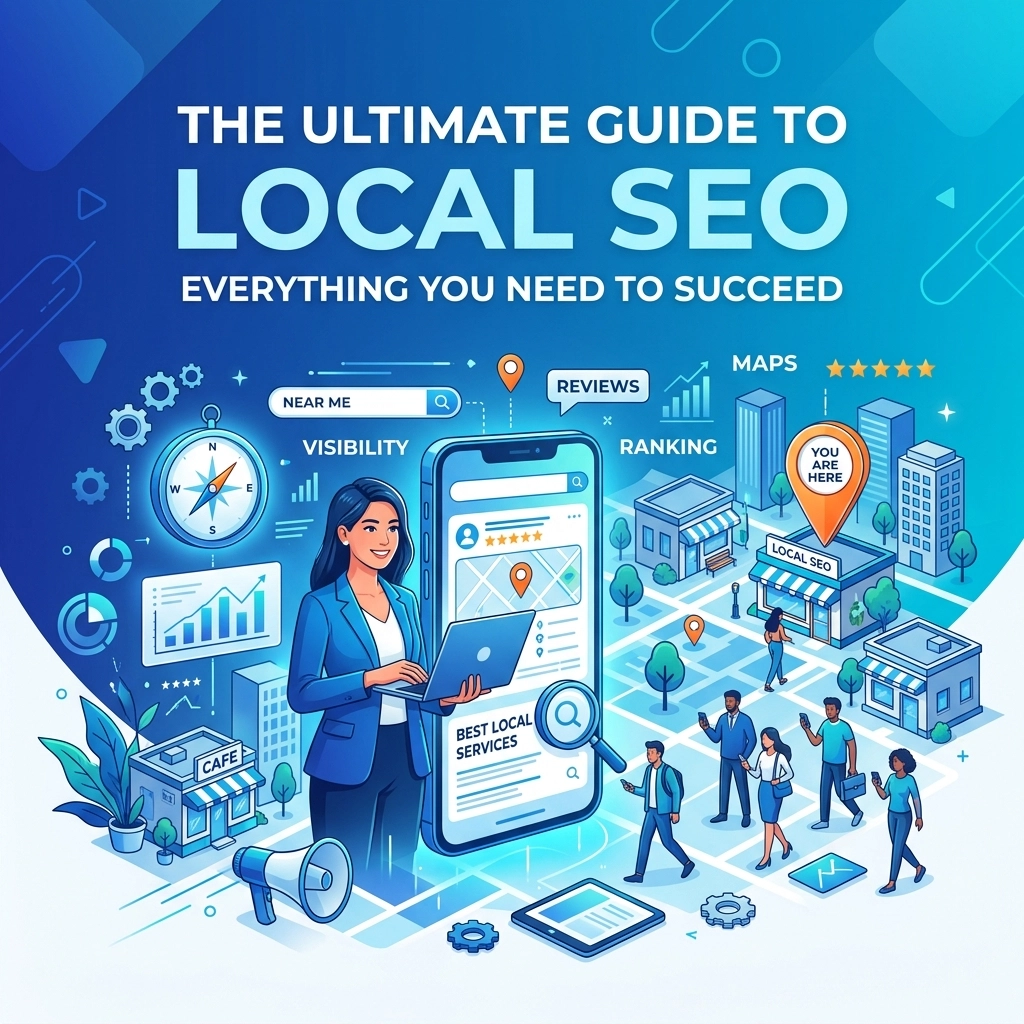

Local SEO is the process of optimizing your online presence to attract more business from relevant local searches. These searches take place on Google and other search engines. Problem: Most small businesses struggle to appear in the "Map Pack" or top local results. Solution: You must implement a specific local strategy that differs from standard organic SEO
This guide covers everything you need to know to rank higher and reach customers in your immediate area
What is Local SEO
Local search engine optimization focuses on physical locations and service areas. When a user searches for "marketing agency near me" or "web design services," search engines use location data to provide the most relevant results. Traditional SEO helps you rank globally, but local SEO ensures people in your community find you first
Why Local Search Matters for Your Business
Statistics show that a large percentage of mobile searches have local intent. Users are often looking for immediate solutions. If your business does not appear in the top three results of the map section, you are losing leads to competitors who have optimized their profiles
Problem: You have a great website but no local traffic. Solution: Optimize for local ranking signals like proximity, relevance, and prominence. We can help you build this foundation through our digital marketing services
Optimizing Your Google Business Profile
Your Google Business Profile is the most important element of local search. It is a free listing that appears in Google Maps and local search results
Claim and Verify Your Listing
You must claim your business to manage the information displayed. Search for your business on Google. If a profile exists, follow the steps to claim it. If not, create a new one. Google will usually send a postcard with a verification code to your physical address to confirm you are actually located there
Complete Every Section
Fill out every detail available in the dashboard. This includes your business name, category, physical address, service area, and phone number. Add your operating hours and keep them updated for holidays. A complete profile is more likely to rank than a partial one

Use High-Quality Images
Upload clear photos of your storefront, your team, and your work. Visuals build trust with potential customers. Profiles with photos receive more clicks and requests for directions than those without them
The Importance of NAP Consistency
NAP stands for Name, Address, and Phone number. Problem: Your business information is different on your website than it is on Yelp or Facebook. Solution: You must audit every online mention of your business to ensure the details are identical
Search engines use this information to verify your legitimacy. If your phone number is different across three platforms, Google loses confidence in your data. This lowers your ranking. Use a single format for your address and stick to it everywhere. If you use "Suite 100" in one place, do not use "#100" in another
Building Local Citations
A citation is any mention of your business online that includes your NAP information. These usually occur in business directories, social media profiles, and industry-specific websites
Top Directories to Target
Start with the major platforms like Bing Places, Apple Maps, Yelp, and Facebook. Then look for local chambers of commerce or industry directories. These citations act as "votes" for your business's location and authority
Auditing Existing Citations
Problem: Old addresses or disconnected phone numbers are floating around the web. Solution: Use tools to find and correct inaccurate citations. Inconsistent data confuses both search engines and customers

On-Page SEO for Local Visibility
Your website needs to be optimized to support your local listings. You cannot rely on your Google profile alone
Dedicated Location Pages
If your business has more than one physical location, create a unique page for each. Each page should include the specific address, phone number, and unique content about that branch. Do not just copy and paste the same text. Mention local landmarks or specific services offered at that site
Local Keywords
Incorporate geographical terms into your headings and meta descriptions. Instead of just "Web Design," use terms that describe your service area. This helps search engines connect your content with the location of the user. You can see how we structure our web design services to be effective for searchers
Embedding Google Maps
Place a Google Map on your contact page. This helps Google confirm your location and makes it easier for customers to find directions. It also improves the user experience by keeping them on your site while they look for your office
Managing Online Reviews
Reviews are a primary ranking factor for local search. They provide social proof and tell search engines that your business is active and reliable
How to Ask for Reviews
Problem: You are doing great work but no one is leaving feedback. Solution: Create a simple process for asking customers for reviews immediately after a service is completed. You can send a follow-up email with a direct link to your Google profile
Responding to All Feedback
You should respond to every review, whether it is positive or negative. Thank happy customers for their business. Address unhappy customers professionally and offer a solution. This shows potential clients that you care about customer service. It also signals to Google that your business is engaged with its audience

Technical SEO and Mobile Performance
Most local searches happen on mobile devices while people are on the go. If your site is slow or hard to navigate on a phone, you will lose the lead
Mobile-First Design
Your website must be responsive. This means it should automatically adjust its layout for smartphones and tablets. Test your site on multiple devices to ensure buttons are easy to click and text is readable. Our team focuses on web and mobile development to ensure high performance across all platforms
Page Speed Matters
Users will leave your site if it takes more than a few seconds to load. Compress your images and minimize heavy code. Use a reliable hosting service to maintain fast load times and high uptime
Local Link Building
Links from other local websites carry significant weight. They show that your business is part of the local community
Partner with Local Organizations
Sponsor a local sports team or charity event. These organizations often link back to their sponsors from their websites. These are high-quality, relevant local links that are hard for competitors to replicate
Guest Posting on Local Blogs
Offer to write helpful content for local news sites or community blogs. This establishes you as an expert and provides a valuable backlink to your site. Focus on being helpful rather than selling your services

Tracking Your Local SEO Progress
You cannot improve what you do not measure. Use tools to see how your local search efforts are performing
Google Search Console and Analytics
Monitor how people are finding your site and which pages they visit. Look for "queries" that include local terms. This will tell you if your keyword strategy is working
Monitoring Map Rankings
Use a local rank tracker to see where your business appears on the map for specific keywords. Rankings can change based on the user's physical location. Track your progress over time to see the impact of your optimizations
Taking the Next Step
Local SEO is not a one-time task. It requires consistent updates to your profile, ongoing review management, and regular content creation. If you want to build a long-term plan, you can view our strategy options to see how we approach growth
Problem: You do not have the time to manage all these technical details. Solution: Reach out to a professional team to handle your digital presence. You can contact us to start a conversation about your specific needs
Implementing these steps will put you ahead of the majority of small businesses that ignore local optimization. Focus on accuracy, consistency, and customer engagement to win the local search game