
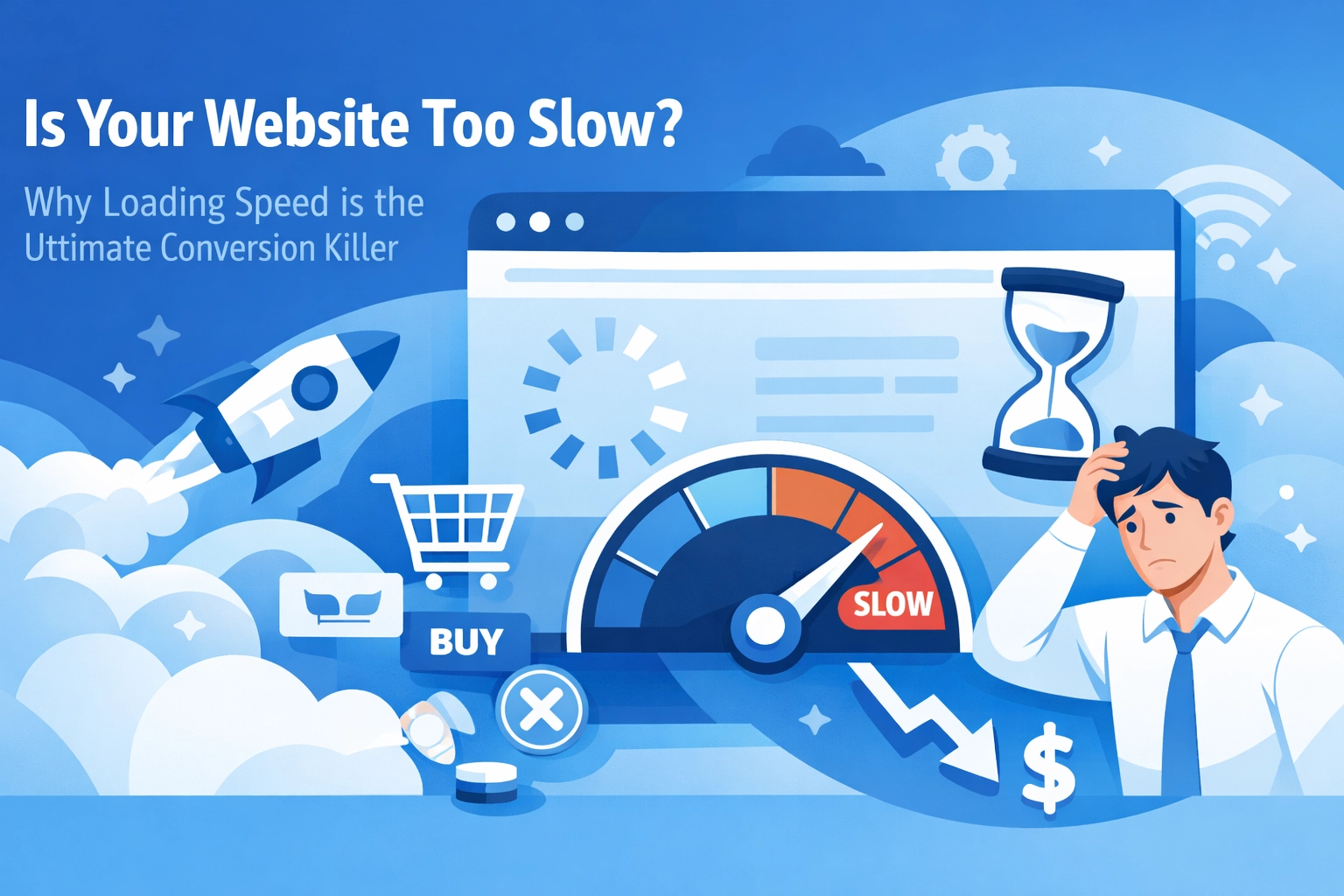

Your website could be costing you thousands in lost revenue every single day. Not because of bad design or weak copy: but because it loads too slowly
The numbers don't lie. A one-second delay in page load time reduces conversions by 7%. That's not a rounding error. That's real money walking away from your business every time someone clicks through to your site
The Speed-to-Conversion Connection
Here's what the data shows: e-commerce conversion rates drop by 0.3% for every additional second of load time. A site that loads in 1 second has a conversion rate 2.5x higher than one that takes 5 seconds
Let's break that down into actual numbers. At a 1-second load time, you're looking at conversion rates around 40%. At 2 seconds, that drops to 34%. By the time you hit 5 seconds, you're operating at roughly half the effectiveness of a fast site
The sweet spot? Between 3.3 and 3.5 seconds. After that, bounce rates skyrocket. Research tracking nearly a quarter million site visits found that 50% more visitors abandon a page when it loads in 3 seconds compared to 2 seconds

Think about your own behavior online. When a page takes forever to load, what do you do? You hit the back button and find a competitor who respects your time
What "Slow" Actually Means
You might think your site is fast enough. You've tested it a few times, and it seems fine. But here's the problem: you're probably testing on a high-speed connection with a recent device
Your customers aren't all using the same setup. Some are on mobile networks. Some have older phones. Some are browsing during peak traffic hours when your server is getting hammered
Industry research shows that even marginal improvements make a massive difference. Shaving off just 0.1 seconds can deliver an 8.4% increase in e-commerce conversions, 10.1% in travel bookings, and 3.6% in luxury sales
That 0.1 second improvement translates to real money. For some businesses, the revenue gap between a 1-second load and a 4-second load exceeds $1,190 per visitor
Why Websites Get Slow
Speed issues don't happen overnight. They accumulate gradually as you add features, content, and functionality
Oversized images are the biggest culprit. That high-res photo looks great, but if it's 5MB, it's killing your load time. Most images on the web should be under 200KB
Unoptimized code is another major issue. Over time, websites accumulate redundant CSS, unused JavaScript, and bloated plugins that all need to load before your page displays
Poor hosting matters more than most businesses realize. Cheap shared hosting might save you $10 a month, but it's costing you exponentially more in lost conversions. When hundreds of sites share the same server resources, everyone suffers

Too many HTTP requests slow everything down. Every external script, font, widget, and tracking pixel requires another round trip to another server. Add them all up and you've got a performance bottleneck
No caching strategy means your server rebuilds the same pages from scratch for every single visitor. That's wasteful and slow
How to Fix Your Speed Problem
Start with measurement. You can't improve what you don't measure. Use Google PageSpeed Insights or GTmetrix to get a baseline. These tools will tell you exactly what's slowing you down
Compress your images immediately. Tools like TinyPNG or ImageOptim can reduce file sizes by 70% or more without noticeable quality loss. Better yet, use modern formats like WebP that offer superior compression
Implement a CDN (Content Delivery Network). Instead of serving all your content from one server location, a CDN distributes it across multiple servers worldwide. When someone visits your site, they get content from the server closest to them
Enable browser caching so returning visitors don't have to reload everything. Their browser stores certain files locally, cutting load times dramatically for subsequent visits

Minify your code. Remove all the unnecessary characters, spaces, and line breaks from your CSS and JavaScript. It won't affect functionality, but it significantly reduces file sizes
Lazy load your images. Don't force browsers to load every image on the page immediately. Load what's visible first, then load the rest as users scroll down
Upgrade your hosting if necessary. The difference between budget hosting and quality managed hosting is like the difference between a bicycle and a sports car. Sometimes you need to spend money to make money
Where Speed Matters Most
Not all pages are created equal when it comes to speed priorities. Focus your optimization efforts where they'll have the biggest impact
Your homepage is critical. It's often the first impression, and first impressions happen in milliseconds. If it's slow, visitors bounce before they even know what you offer
Product pages and category pages are where buying decisions happen. A slow-loading product page doesn't just frustrate users: it actively prevents them from giving you money
Checkout pages are the final conversion point. If someone makes it all the way to checkout and then encounters a slow page, you've lost a sale you already had. Research shows that high-intent pages like checkout, login, and registration deserve priority attention
The Mobile Speed Factor
Over half of web traffic now comes from mobile devices. If your site isn't fast on mobile, you're failing the majority of your potential customers
Mobile connections are typically slower than desktop. Mobile processors are less powerful. Mobile users are more impatient because they're often on-the-go
Google now uses mobile-first indexing, meaning they rank your site based primarily on its mobile performance. A slow mobile site isn't just bad for conversions: it's bad for SEO too

Test your site on actual mobile devices, not just the developer tools on your desktop. The real-world experience is often worse than simulated tests suggest
The Competitive Advantage
Here's the reality: most websites are slow. If you make yours fast, you immediately stand out from the competition
When users are comparing options, speed influences their perception of your entire business. A fast site signals competence, professionalism, and respect for customers' time. A slow site suggests the opposite
The businesses winning online aren't necessarily those with the biggest budgets or flashiest designs. They're the ones that load quickly, function smoothly, and make it easy for customers to buy
Speed Is a Feature, Not a Nice-to-Have
Stop thinking about website speed as a technical detail someone else worries about. It's a core feature that directly impacts your bottom line
Every second counts. Every unnecessary kilobyte matters. Every optimization opportunity is a chance to increase revenue
The good news? You don't need to fix everything at once. Start with the biggest issues: usually images and hosting: and work your way down the list. Even small improvements compound quickly
Your website should work for you, not against you. If it's slow, it's actively sabotaging your business goals. The question isn't whether you can afford to optimize: it's whether you can afford not to
Need help getting your site up to speed? WorldWise specializes in building fast, conversion-focused websites that actually perform. We can audit your current site, identify what's slowing you down, and implement solutions that deliver measurable results.