
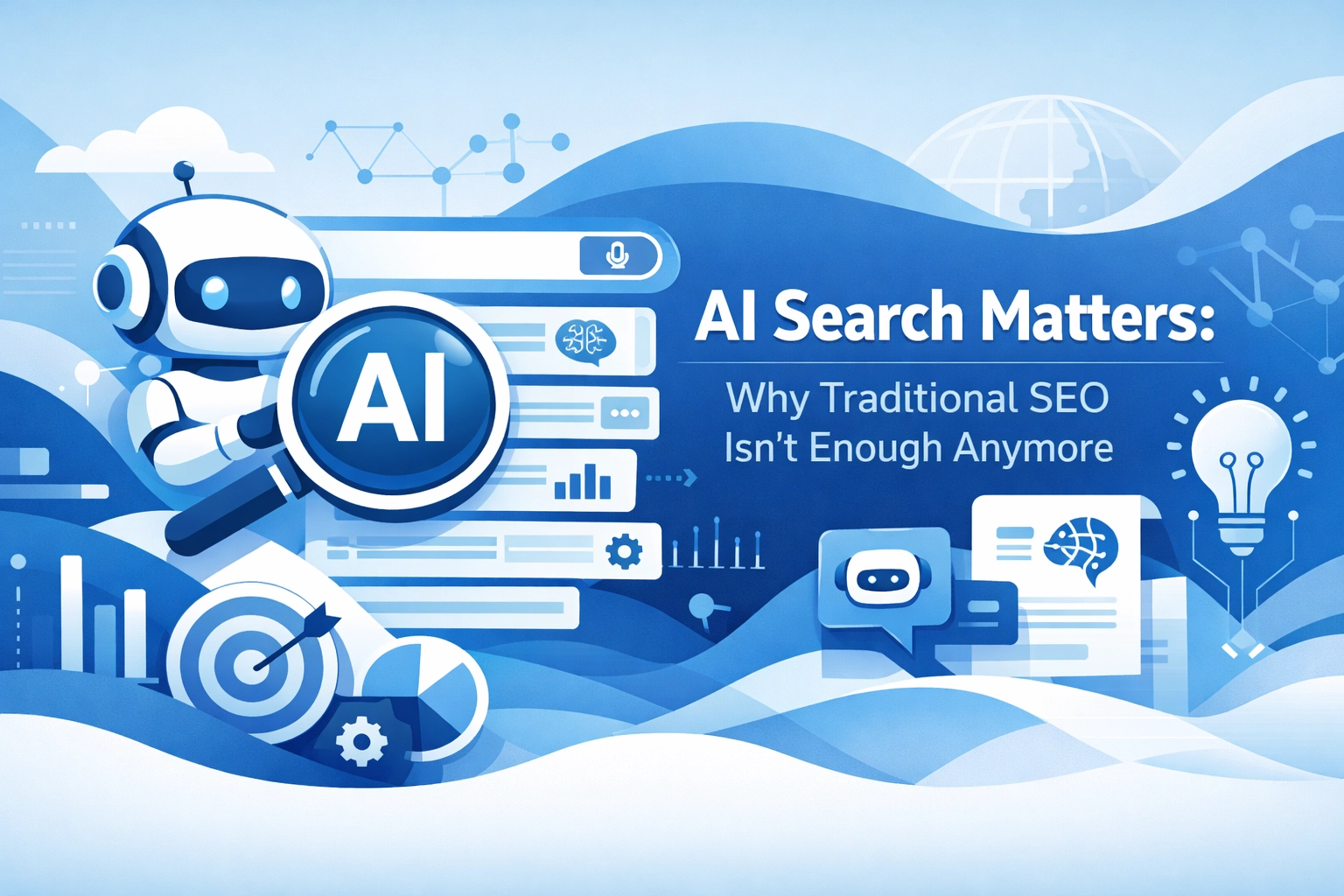

The internet just got a massive brain transplant and your current strategy might be stuck in the donor bin. For two decades we played a simple game: pick a keyword, build a link, and hope Google puts you in the "top ten." It was predictable. It was a bit boring. And now it is mostly irrelevant if you are still playing by those rules alone
The shift from traditional search engines to AI-driven "answer engines" is the biggest disruption to digital marketing since the smartphone. If you are still obsessing over whether you rank #3 or #4 for a specific phrase you are missing the forest for the trees. The "trees" are now being summarized by a robot that does not always feel like sending traffic your way
Here is the cold truth. Traditional SEO focuses on ranking links in a list. AI search focuses on providing the answer directly to the user. If the AI answers the question using your data but never mentions your name or gives a link to your site you have lost. This is why AI search matters and why your old playbook needs a serious rewrite
The death of the ten blue links
Remember when you would search for "how to fix a leaky faucet" and get a page of ten websites? You would click one, look around, maybe click another. That is "Traditional SEO." It relies on the user doing the heavy lifting of clicking and reading
Today you ask an AI and it tells you exactly which wrench to grab and which valve to turn. It might cite a source but the user rarely clicks through. This is called a "zero-click search" and it is becoming the new normal. If your Digital Marketing strategy is built entirely on getting clicks from a results page you are going to see your traffic drop even if your rankings stay the same
The problem is not that people stopped searching. The problem is that the way they consume the search results has fundamentally changed. You are no longer competing with other websites. You are competing with the AI’s ability to summarize you
Why keywords are losing their crown
In the old days we would stuff "best pizza near me" or "affordable web design" into a page and call it a day. Search engines were basically giant filing cabinets. They looked for the label on the folder and matched it to the query
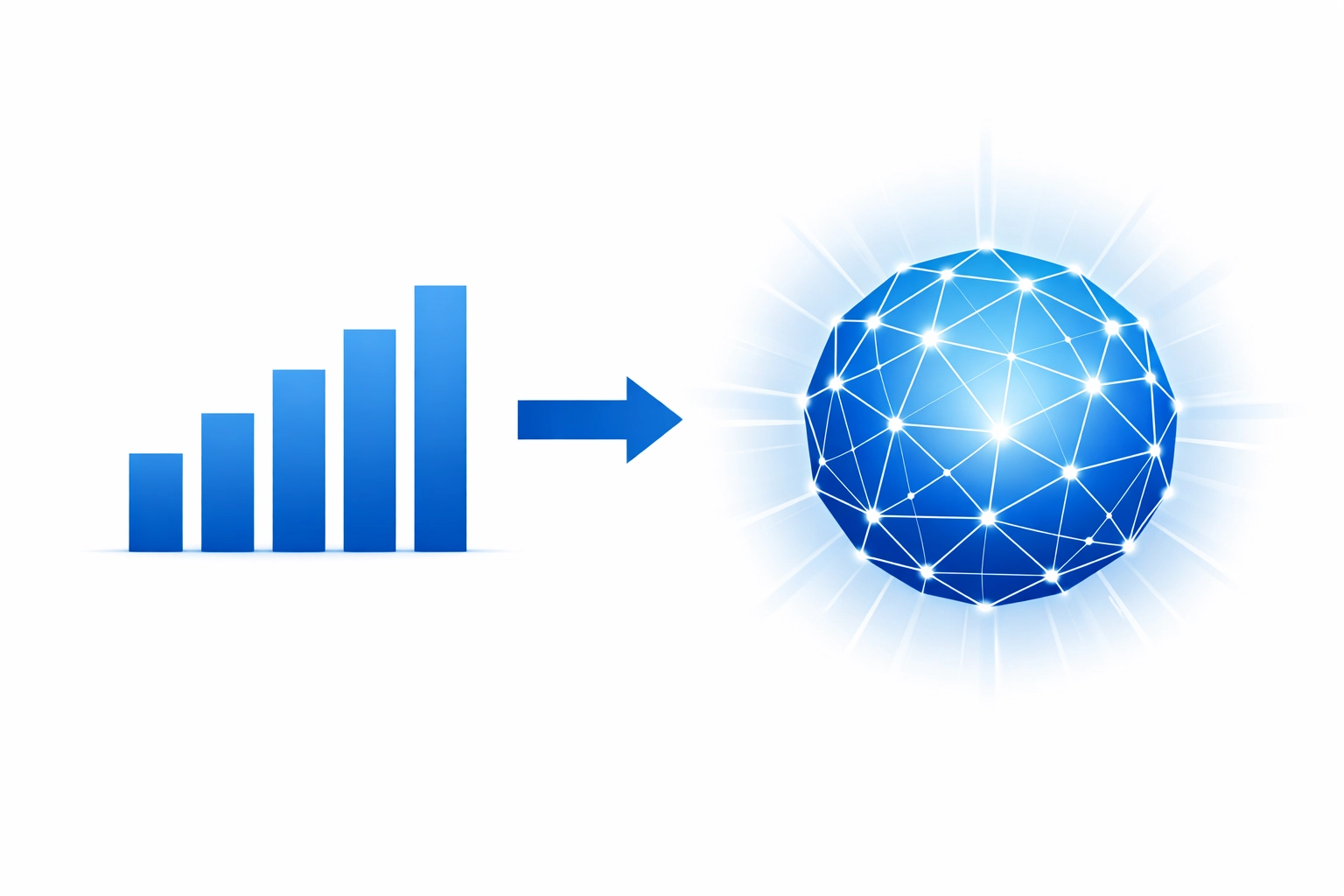
AI models like GPT-4 or Claude do not work like filing cabinets. They work like humans who have read every book in the library. They understand context, intent, and nuance. They do not care if you used the word "affordable" five times. They care if your content actually explains why your service is a good value. This shift from "keywords" to "entities and intent" means your content needs to be smarter
If your website looks like it was written by a robot from 2012 the new AI search engines will sniff it out. They prefer natural language and authoritative voices. This is where a high-quality Web Design strategy comes in. It is not just about looking pretty. It is about structuring information so both humans and AI can find what they need without a struggle
The rise of chunkable content
If you want AI to cite you it has to be able to "digest" you easily. Imagine the AI is a busy executive who only has time to read bullet points. If your website is one giant wall of text the AI is going to skip it for a site that is better organized
We call this "chunkable" content. It means using clear headers, short sentences, and direct answers. Instead of a 2,000-word essay on the history of technology start with a clear section that answers "What is AI Search?" right at the top. Use H2 and H3 tags to break down topics. Provide data in tables. Use lists
When an AI searches the web for an answer it looks for the most "machine-readable" explanation. If you make its job easy it will reward you with a citation. If you make it hard it will just find the answer somewhere else

Authority is the new currency
In traditional SEO we obsessed over backlinks. If a big site linked to you Google thought you were cool. While links still matter AI search looks at "Social Proof" and "Verifiability" on a much broader scale
AI models look for consistency. If your site says you are an expert in Managed IT but no one else on the internet mentions your brand or your experts the AI might ignore you. It cross-references facts. If your content is factually inconsistent with the rest of the web the AI will flag you as unreliable
This is why brand building is now part of SEO. You need a presence on social media, in industry journals, and in news outlets. The AI needs to see your "footprint" across the entire web to trust that you are a legitimate source of information. It is no longer just about what you say on your own site. It is about what the world says about you
The technical foundation still matters
You might think that because AI is "smart" it does not care about the technical stuff. Wrong. If your site is slow or broken the AI crawlers will get frustrated and leave just like a human would. In fact technical health is more important than ever because AI crawlers are constantly scanning the web and they have limited "crawl budgets"
Your Web Hosting needs to be fast. Your site needs to be secure. If an AI sees a security warning on your site it is not going to recommend you to a user. Security and trust are massive signals for modern search algorithms. This is why we tell our clients that Cybersecurity is actually a marketing tool. A safe site is a site that gets recommended

How to optimize for the AI era
So how do you actually win in this new landscape? You stop trying to trick the engine and start trying to be the most helpful resource available. Here is the blueprint we suggest for most businesses found today
First simplify your language. Stop using corporate jargon that says nothing. Use direct, matter-of-fact statements. Instead of saying "We provide synergistic solutions for digital growth" say "We build websites that help you sell more products"
Second implement structured data (Schema). This is code you add to your site that tells search engines exactly what they are looking at. It tells them "This is a price," "This is a review," and "This is a physical address." AI loves structured data because it does not have to guess what the information means
Third focus on FAQ sections. People ask AI questions. If your website has clear, concise answers to those specific questions you are much more likely to appear in the AI’s generated response. Think about the top 10 questions your customers ask and dedicate a page: or a section of every page: to answering them directly
The hybrid approach
Do not throw your traditional SEO out the window just yet. AI models often use high-ranking search results as their primary sources. If you rank #1 on Google for a topic you are the most likely source for the AI to summarize. Traditional SEO and AI SEO are not enemies. They are teammates
The goal is to maintain your technical rankings while evolving your content to be "AI-friendly." This means keeping your SEO Strategy updated with the latest trends while ensuring your site architecture is modern and clean

Stop waiting for the old web to come back
The internet of 2026 is not the internet of 2020. The way people find information has changed forever. If you are still waiting for your traffic numbers to "go back to normal" without changing your approach you are going to be waiting a long time
The businesses that thrive in this new era are the ones that embrace transparency, authority, and technical excellence. They do not just build websites. They build resources. They do not just write blogs. They provide answers
If you are feeling overwhelmed by the shift from keywords to AI citations you are not alone. The landscape is moving fast but the fundamentals of being helpful and trustworthy remain the same. You just need a partner who knows how to translate those fundamentals into the language the new AI search engines understand
Ready to see how your site stacks up in the age of AI search? We can help you navigate the transition from traditional SEO to a modern, AI-ready digital presence. Check out our Marketing services or Contact us to get started on a strategy that actually works for 2026 and beyond