
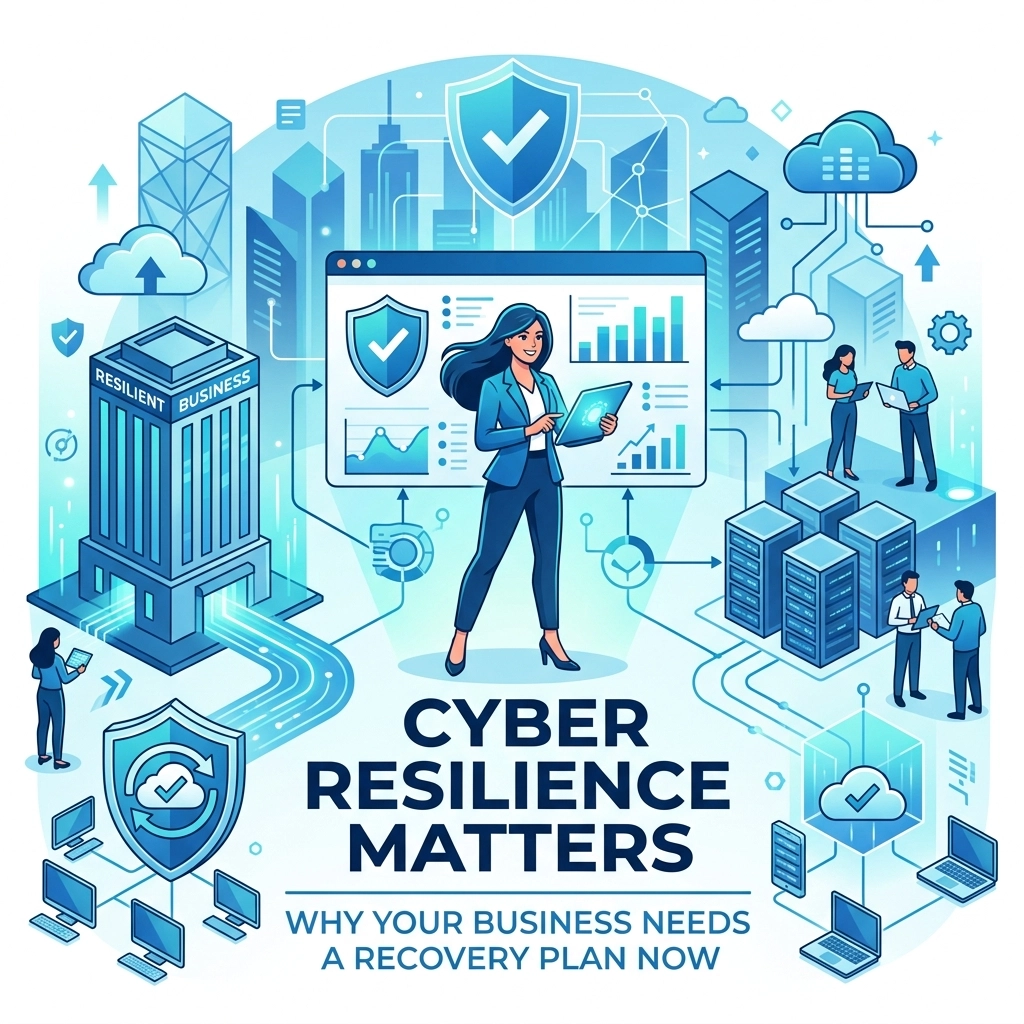

Cybersecurity is no longer about just building a wall. In 2026 hackers are more sophisticated and they use AI to find cracks in your defense that traditional software might miss. If you think your business is too small to be a target you are mistaken. Small businesses are often the preferred targets because they usually have weaker security and no clear plan for when things go wrong
We see it all the time at WorldWise. A company loses access to its data and realizes too late that its last backup was six months ago. That is not just a technical glitch. It is a business-ending event. Cyber resilience is the ability to take a hit and keep moving. It is about business continuity and making sure a single attack does not shut you down for good
The Difference Between Cybersecurity and Cyber Resilience
Most people use these terms interchangeably but they mean different things. Cybersecurity is the collection of tools and strategies you use to prevent an attack. This includes firewalls, antivirus software, and multi-factor authentication. It is your primary shield
Cyber resilience is broader. It assumes that at some point your shield will fail. Someone will click a bad link or a zero-day exploit will bypass your firewall. Resilience is what happens next. It involves your ability to detect the breach quickly, contain the damage, and restore operations with minimal downtime
If you only focus on cybersecurity you are gambling on being perfect 100% of the time. If you focus on cyber resilience you are preparing for reality. You need a recovery plan because the cost of being offline is often higher than the cost of the ransom itself

Why You Cannot Afford Downtime
When your systems go down your revenue stops but your expenses do not. You still have to pay rent, utilities, and salaries. Beyond the immediate financial loss there is reputational damage. Customers expect instant access to services. If your website is down or you cannot fulfill orders they will go to a competitor
Data shows that a significant percentage of small businesses that experience a major data loss close within a year. They cannot recover from the combination of lost sales, legal fees, and the cost of rebuilding their digital infrastructure. This is why business continuity is the core of our managed IT services. We do not just fix computers we protect your ability to operate
The Foundation of Resilience is Data Backup
You cannot have a recovery plan without a solid data backup strategy. If your data is gone and you do not have a clean copy to restore your business is essentially starting from scratch. We recommend the 3-2-1 rule for all our clients
- Keep at least three copies of your data
- Store the copies on two different types of media
- Keep at least one copy off-site
In the modern era that off-site copy should be a secure cloud environment. At WorldWise we integrate automated data backup solutions that run in the background. This ensures that even if your local hardware is destroyed by fire or encrypted by ransomware you have a safe version of your files ready to go

Key Components of a Business Recovery Plan
A recovery plan is a written document that tells your team exactly what to do when a crisis hits. It should not be complicated but it must be thorough. If you are starting from zero here is what we suggest you include
Asset Inventory
You cannot protect what you do not know you have. Create a list of every device, software application, and data set your business uses. Identify which ones are critical for daily operations. Your email system and customer database are likely at the top of that list
Risk Assessment
Identify the most likely threats to your business. This includes cybersecurity threats like phishing and ransomware but also physical threats like hardware failure. Knowing the risks helps you prioritize your spending on protection
Recovery Time Objectives (RTO)
How long can your business survive without its systems? Your RTO is the maximum amount of time you can be offline before the damage becomes irreversible. For some businesses this is an hour. For others it might be a day. Knowing this number dictates how fast your backup systems need to be
Recovery Point Objectives (RPO)
How much data can you afford to lose? If your system crashes at 4:00 PM and your last backup was at 8:00 AM you have lost eight hours of work. Your RPO determines how frequently you need to run your backups
Roles and Responsibilities
When a breach happens everyone needs to know their job. Who calls the IT team? Who notifies the customers? Who handles the legal implications? Having these roles assigned in advance prevents panic and speeds up the recovery process

The Role of Managed IT Services
Most small business owners do not have the time to manage complex IT infrastructure and stay updated on the latest security threats. That is where WorldWise comes in. We provide managed IT services that act as an extension of your team
We handle the heavy lifting of computer support and network monitoring. Our goal is to catch problems before they turn into disasters. Proactive monitoring means we see the signs of a failing hard drive or a suspicious login attempt before you even know there is an issue
By outsourcing your IT management you get access to enterprise-level tools and expertise without the cost of a full-time in-house IT department. We ensure your software is patched, your backups are verified, and your team is trained to spot threats
Human Error is Your Biggest Vulnerability
You can have the most expensive firewall in the world but it won't matter if an employee gives away their password. Human error is responsible for the vast majority of security breaches. This is why a recovery plan must include regular training
Teach your team how to recognize phishing emails. Explain why they should never use the same password for multiple accounts. Implement a culture where it is okay to report a mistake immediately. The sooner a breach is reported the faster we can contain it

Testing Your Plan
A recovery plan that has never been tested is just a piece of paper. You need to run drills to make sure your backups actually work and your team knows the protocols. We suggest doing a full recovery test at least once a year
During a test we simulate a system failure and see how long it takes to get everything back online. This often reveals gaps in the plan that we can fix before a real emergency happens. Testing gives you the confidence that your business is truly resilient
Steps to Take Right Now
If you do not have a recovery plan do not wait until Monday to start. The digital world does not take the weekend off. Here is a simple checklist to get you moving in the right direction
- Check your current backups and make sure they are actually running
- Update your passwords and enable multi-factor authentication on all sensitive accounts
- Identify your most critical data and ensure it is stored securely
- Contact a professional IT service provider to audit your current setup
You can visit our get started page to see how we can help you build a more resilient infrastructure. We specialize in creating custom strategies that fit the specific needs of your business
Why WorldWise is the Right Partner
We understand that you want to focus on growing your business not worrying about your servers. Our approach to managed IT services is focused on results and reliability. we provide the technical foundation so you can do your best work
Whether you need help with web design to attract new clients or robust backend support to keep your data safe we have the expertise to help. Cyber resilience is not a one-time project. It is an ongoing commitment to your business's future
Do not let a single cyber incident be the end of your story. Build a plan. Back up your data. Stay resilient. If you need a hand getting your technology where it needs to be reach out to us at WorldWise today