

Here's the situation most growing businesses find themselves in: your technology works fine until it doesn't. Your team can handle basic IT issues until they can't. And hiring a full-time IT staff makes sense until you look at the actual numbers.
This is the inflection point where managed IT support stops being a luxury and starts being a strategic business decision. But how do you know if you've actually reached that point?
Let's cut through the marketing noise and look at what managed IT support actually delivers: and whether your business genuinely needs it.
The Real Cost of Managing IT Yourself
Most business owners dramatically underestimate what IT management actually costs when handled internally.
You're not just paying for the occasional software update or password reset. You're absorbing hidden costs that don't show up on any invoice:
Your staff becomes your IT department by default. When something breaks, who fixes it? Probably someone whose actual job description has nothing to do with technology. That's billable time lost on troubleshooting instead of revenue-generating work.
Reactive spending replaces strategic planning. Without dedicated IT oversight, you're constantly responding to emergencies rather than preventing them. That server that crashes? You're paying emergency rates to fix it instead of maintenance costs to keep it running.
Security becomes an afterthought. Growing businesses are prime targets for cyberattacks precisely because they lack mature security infrastructure. One successful breach can cost more than years of managed IT support services.
The math gets worse as you scale. More employees mean more devices, more software licenses, more integration challenges, and exponentially more things that can go wrong.
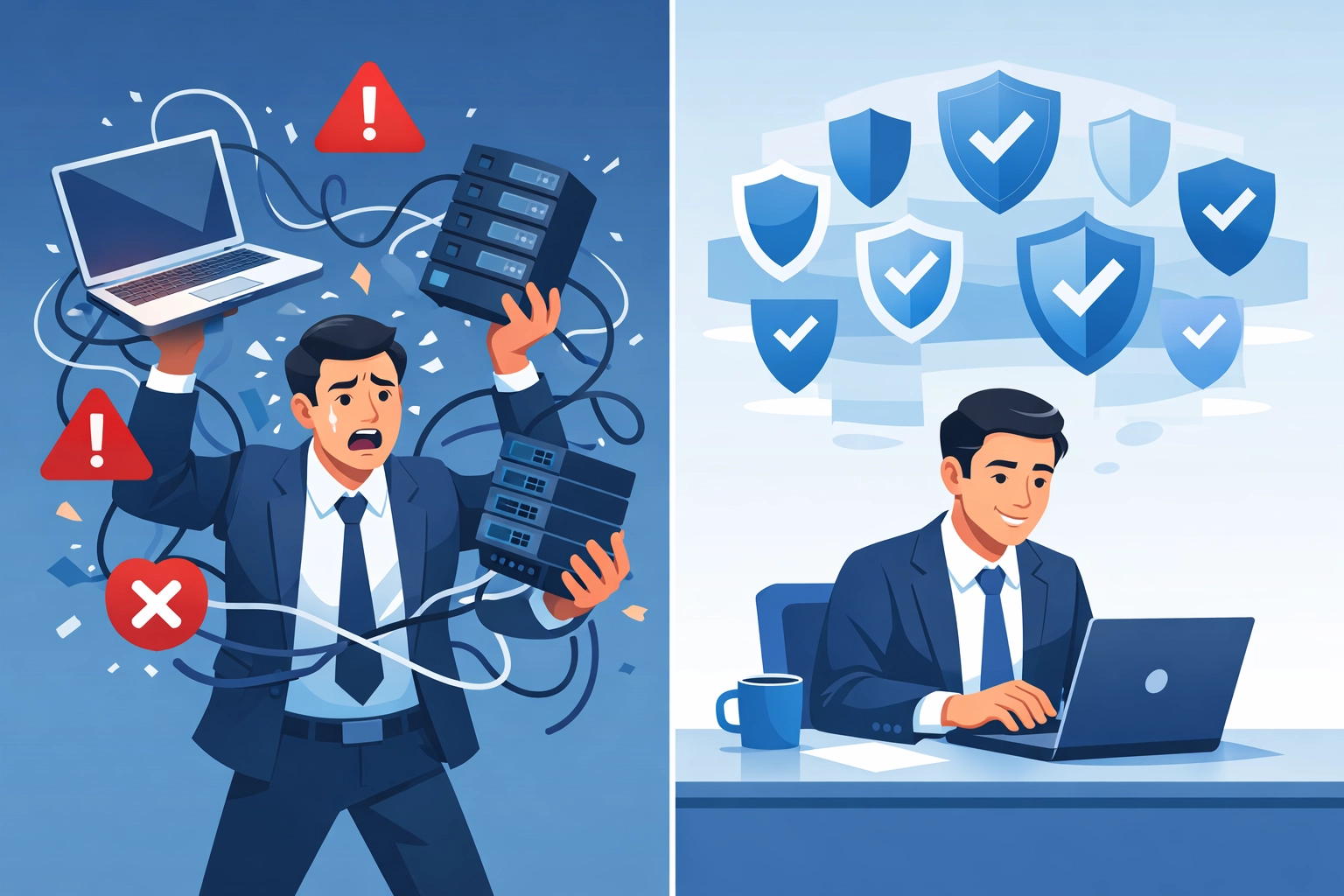
When Managed IT Support Actually Makes Sense
Not every business needs managed IT support immediately. A three-person startup running entirely on cloud software has different needs than a 30-person company with hybrid infrastructure.
Here's when managed IT support transitions from "nice to have" to "business critical":
You're scaling headcount rapidly. Every new employee needs equipment, access credentials, software licenses, and security protocols. If onboarding new team members takes days instead of hours because of IT setup, you have a scaling problem.
Downtime is costing you real money. Calculate what an hour of system downtime actually costs your business in lost productivity and revenue. If that number makes you uncomfortable, you need proactive monitoring and maintenance.
You're handling sensitive data. Customer information, financial records, healthcare data, or any regulated information requires compliance frameworks that most internal teams can't maintain without dedicated expertise.
Your "IT person" is actually your office manager. Or your marketing director. Or whoever happens to be most tech-savvy. When non-IT staff are pulled into technical troubleshooting, you're paying their salary for work outside their expertise.
You're planning technology investments. Cloud migration, new software implementation, or infrastructure upgrades require strategic planning. Making these decisions without IT expertise often leads to expensive mistakes that take years to unwind.
What Managed IT Support Actually Includes
The term "managed IT support" covers a wide range of services. Understanding what you're actually paying for helps determine if it's worth the investment.
Proactive monitoring and maintenance. Instead of waiting for things to break, managed service providers monitor your systems 24/7 and address issues before they cause downtime. This includes software updates, security patches, and performance optimization.
Help desk support. Your team gets access to actual IT professionals when they need help: not a coworker who's Googling the same problem they are. Response times are contractually guaranteed, not dependent on someone's availability.
Security management. This includes firewall configuration, antivirus management, security training, vulnerability assessments, and incident response planning. You're not just protected: you're compliant with industry regulations.
Strategic IT planning. Good managed IT providers don't just keep the lights on. They help you plan technology investments that align with business growth, avoid costly mistakes, and ensure your infrastructure can scale with you.
Disaster recovery and backup. Your data is systematically backed up and recoverable. If something catastrophic happens, you have a documented plan and the resources to execute it quickly.

The Real ROI Nobody Talks About
The financial case for managed IT support isn't just about cost comparison: it's about unlocking growth that wouldn't otherwise be possible.
Predictable budgeting. Monthly subscription costs replace unpredictable emergency expenses. You know exactly what IT will cost this quarter and next year, which makes financial planning dramatically easier.
Your team focuses on actual work. When employees aren't troubleshooting printer issues or resetting passwords, they're doing the work you actually hired them for. That productivity gain often pays for managed IT support by itself.
You avoid expensive mistakes. Technology decisions made without expertise often create technical debt that takes years and significant money to fix. A managed IT provider helps you avoid these costly missteps entirely.
You can compete with larger companies. Access to enterprise-level IT infrastructure and expertise levels the playing field. You get the same capabilities as companies with full IT departments at a fraction of the cost.
Downtime drops to near zero. With proactive monitoring and maintenance, most issues are resolved before they impact your team. The productivity saved from eliminating even a few hours of downtime monthly adds up quickly.
The Alternative: Co-Managed IT
If you already have internal IT staff but they're overwhelmed, co-managed IT support might be the better solution.
This model keeps your internal team focused on strategic initiatives while the managed service provider handles routine maintenance, after-hours support, and specialized projects. Your IT staff gets backup without losing control.
Co-managed arrangements work well for businesses that:
- Have outgrown a single IT person but can't justify a full department
- Need specialized expertise for specific projects
- Want 24/7 coverage without hiring multiple shifts
- Have internal IT focused on strategic work rather than day-to-day maintenance
Making the Decision
Here's a practical framework for deciding whether managed IT support makes sense for your business right now.
Calculate your current IT costs honestly. Include staff time spent on IT issues, emergency repairs, software licenses, hardware replacements, and security tools. Most businesses are surprised by the actual total.
Project your growth. How many employees will you have in 12 months? What new systems or software will you need? Can your current IT approach scale with that growth?
Assess your risk tolerance. What would a security breach cost your business? What about a full day of downtime? How much are you willing to spend to prevent those scenarios?
Compare the numbers. Get quotes from managed IT providers and compare them against your current costs plus projected growth needs. Factor in the productivity gains from reducing downtime and freeing staff from IT troubleshooting.
The decision often becomes clear when you look at the complete picture rather than just comparing monthly costs.
What to Look for in a Provider
If you decide managed IT support makes sense, choosing the right provider matters as much as making the decision itself.
Look for providers who:
- Offer transparent pricing without hidden fees
- Have experience with businesses at your stage and in your industry
- Provide contractually guaranteed response times
- Include proactive monitoring and maintenance, not just reactive support
- Can demonstrate their security protocols and compliance capabilities
- Offer scalable services that grow with your business
The cheapest option is rarely the best choice. You're not just buying IT support: you're forming a technology partnership that directly impacts your ability to operate and grow.
The Bottom Line
Growing businesses don't need managed IT support because it's trendy or because everyone else has it. You need it when the alternative: managing IT internally: costs more in time, money, and risk than outsourcing it to experts.
If your team is spending hours on IT issues instead of revenue-generating work, if downtime is a recurring problem, or if you're planning significant growth, managed IT support transitions from optional to essential.
The question isn't whether you can afford managed IT support. It's whether you can afford not to have it.
Want to understand exactly what managed IT support would look like for your business? Get in touch and we'll walk through your specific situation: no sales pitch, just honest assessment of what you actually need.