
Your business is growing. Your team is expanding. And suddenly, your IT needs are becoming more complex than one person can handle.
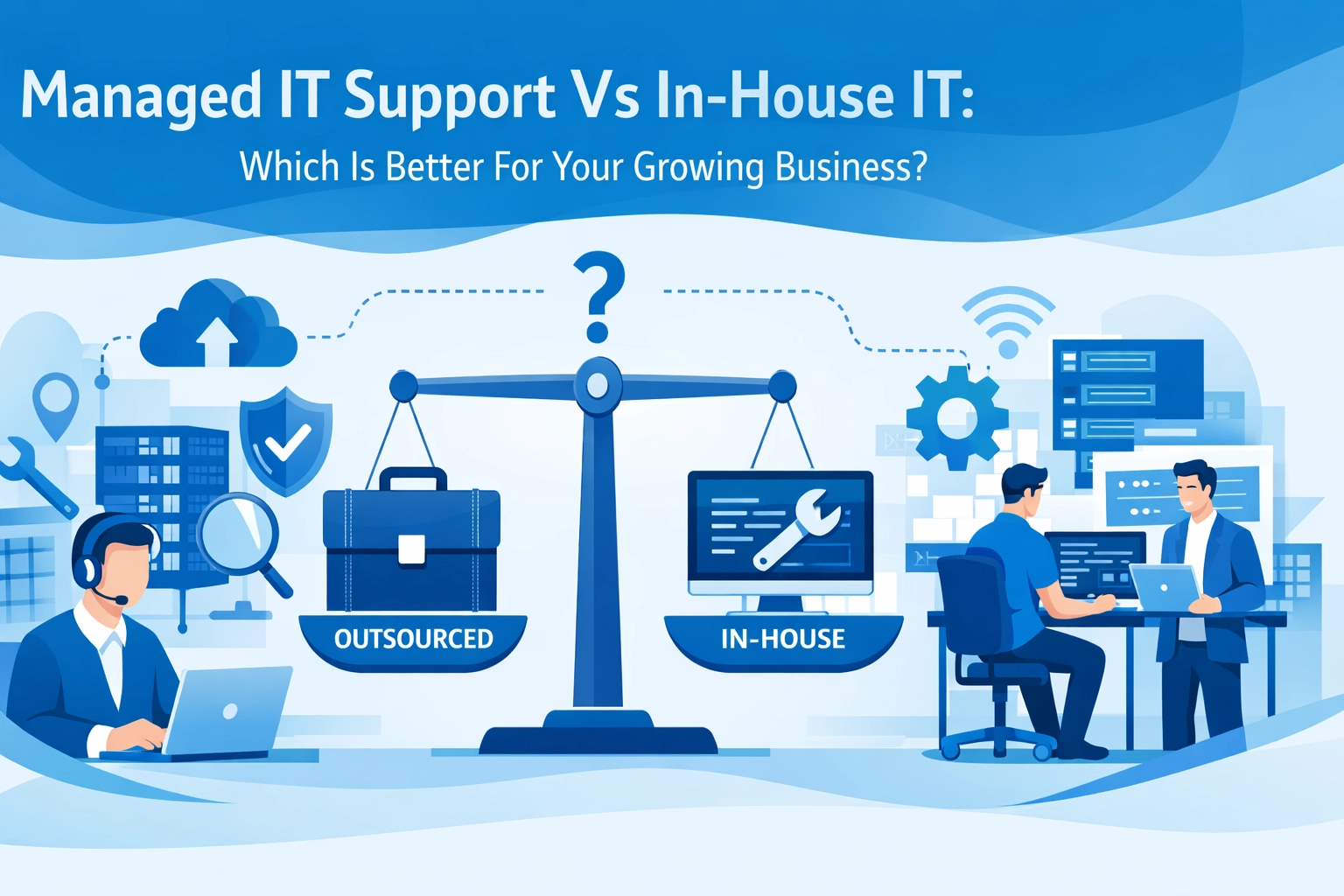
You're facing a critical decision: Should you build an in-house IT team or partner with a managed IT service provider? The answer isn't always obvious, and the wrong choice can cost you thousands in wasted resources and lost productivity.
Let's break down both options so you can make the right call for your business.
What Is Managed IT Support?
Managed IT support means outsourcing your technology infrastructure to a specialized service provider. Instead of hiring full-time employees, you pay a monthly fee for access to a team of IT professionals who handle everything from network monitoring to cybersecurity.
Think of it as having an entire IT department on call without the overhead of salaries, benefits, and training costs. Your managed IT support partner becomes an extension of your team, working proactively to prevent issues before they disrupt your operations.
What Is In-House IT?
In-house IT means hiring dedicated employees who work exclusively for your company. They're physically present in your office, understand your systems intimately, and report directly to your leadership team.
These employees become part of your company culture and build deep knowledge about your specific technology needs. They're available whenever you need them and can customize solutions that align perfectly with your business processes.
The Real Cost Comparison
At first glance, managed IT support might seem more expensive. You're paying for a service instead of just a salary, right?
Not quite. When you calculate the true cost of in-house IT, you need to factor in:
- Annual salaries for multiple specialists (network admin, security expert, help desk support)
- Benefits packages including health insurance and retirement contributions
- Ongoing training and certification costs
- Recruitment and onboarding expenses when someone leaves
- Hardware and software tools for your IT team
- Time spent managing and supervising IT staff
A single experienced IT professional can easily cost $80,000-$120,000 per year before benefits. And you need at least 2-3 people to cover all your bases.
Managed IT support typically runs $100-$200 per user per month. For a 25-person company, that's $2,500-$5,000 monthly for comprehensive coverage. That's $30,000-$60,000 annually for access to an entire team of specialists.
The math speaks for itself.

Scalability: Growing Without Growing Pains
Here's where managed IT support really shines for growing businesses.
When you hire in-house, you're locked into fixed costs regardless of your needs. Slow quarter? You're still paying full salaries. Rapid expansion? You need to recruit, interview, and train new staff while your systems are already straining.
With managed IT, you scale services up or down based on current needs. Adding 10 new employees? Your provider adjusts coverage immediately. Launching a new location? They extend support without you posting a single job listing.
This flexibility is invaluable when your business trajectory isn't perfectly predictable.
Access to Specialized Expertise
Technology evolves fast. Really fast.
Cybersecurity threats change daily. Cloud platforms release new features monthly. Compliance requirements update constantly. Keeping pace requires continuous learning and specialization.
An in-house IT person might be great at network administration but lack deep expertise in cybersecurity or cloud architecture. Hiring specialists for every domain becomes prohibitively expensive for most growing businesses.
Managed IT providers employ teams of specialists across all technology domains. Need a cloud migration expert? They've got one. Concerned about ransomware protection? Their security team stays current on the latest threats. Evaluating new software? They've probably implemented it for other clients already.
You get enterprise-level expertise without enterprise-level hiring costs.
24/7 Monitoring and Support
Technology doesn't sleep. Your server doesn't care that it's 2 AM on a Saturday when it decides to fail.
In-house IT staff work normal business hours unless you're paying overtime or hiring multiple shifts. A weekend outage can mean lost revenue and frustrated customers until Monday morning.
Managed IT providers offer round-the-clock monitoring and support. Automated systems detect issues before they become critical. If something does go wrong at midnight, a qualified technician responds immediately.
This proactive approach minimizes downtime and keeps your business running smoothly regardless of when problems occur.

When In-House IT Makes More Sense
Managed IT isn't always the answer. Some situations genuinely call for in-house staff.
Consider building an internal IT team if:
You have highly specialized or proprietary systems that require constant hands-on attention and deep customization. If your technology is truly unique, outside providers may struggle to deliver the specialized support you need.
You operate in a high-security environment where data cannot leave your physical premises under any circumstances. Some industries have regulatory requirements that make external management difficult or impossible.
You have consistent, high-volume on-site support needs. If employees constantly need immediate physical help with hardware issues, having someone in the building makes sense.
You have budget for specialized talent and can afford to hire, train, and retain multiple IT professionals across different specialties.
Your technology stack is stable and unchanging. If you're not adopting new tools or expanding your infrastructure, the benefits of managed services diminish.
For most growing businesses, these conditions don't apply. Your needs are evolving, your budget is constrained, and you need flexibility more than absolute control.
The Hybrid Approach
You're not limited to an all-or-nothing choice.
Many successful businesses adopt a hybrid model: keeping one in-house IT manager or coordinator while outsourcing specialized functions to a managed service provider.
Your in-house person handles day-to-day requests, maintains relationships with employees, and serves as a liaison with your managed IT partner. The external team provides 24/7 monitoring, specialized expertise, and additional support during peak times.
This approach gives you on-site presence without the cost and complexity of building a full department. It's particularly effective for businesses with 50-200 employees who need more than fully outsourced support but can't justify a complete IT department.
Making Your Decision
Start by honestly assessing your current situation:
What are your actual IT needs? List every technology function your business requires: network management, cybersecurity, help desk support, cloud services, backup and disaster recovery, software updates, and hardware maintenance.
What's your realistic budget? Calculate the true cost of hiring and retaining qualified staff versus partnering with a managed provider. Don't forget the hidden costs of recruitment, training, and turnover.
How fast are you growing? Rapid growth demands scalable solutions. If your headcount or technology needs fluctuate significantly, flexibility matters more than fixed staff.
What's your risk tolerance? Downtime costs money. Calculate what an hour of system unavailability actually costs your business in lost productivity and revenue.
Where should leadership focus? Your time and energy are limited. Do you want to manage IT staff or invest those hours in growing your core business?
For most growing businesses, managed IT support provides better value, greater expertise, and more flexibility than building an in-house team from scratch.
Ready to Make the Switch?
If you're leaning toward managed IT support, the next step is finding the right partner.
Look for providers who understand your industry, offer transparent pricing, and prioritize proactive maintenance over reactive firefighting. The best partnerships feel less like vendor relationships and more like having an extended team working toward your success.
WorldWise helps growing businesses make smarter technology decisions without overspending on unnecessary infrastructure. Our managed IT support keeps your systems running smoothly so you can focus on what you do best.
Get started today and see how the right IT strategy can accelerate your growth instead of holding it back.