
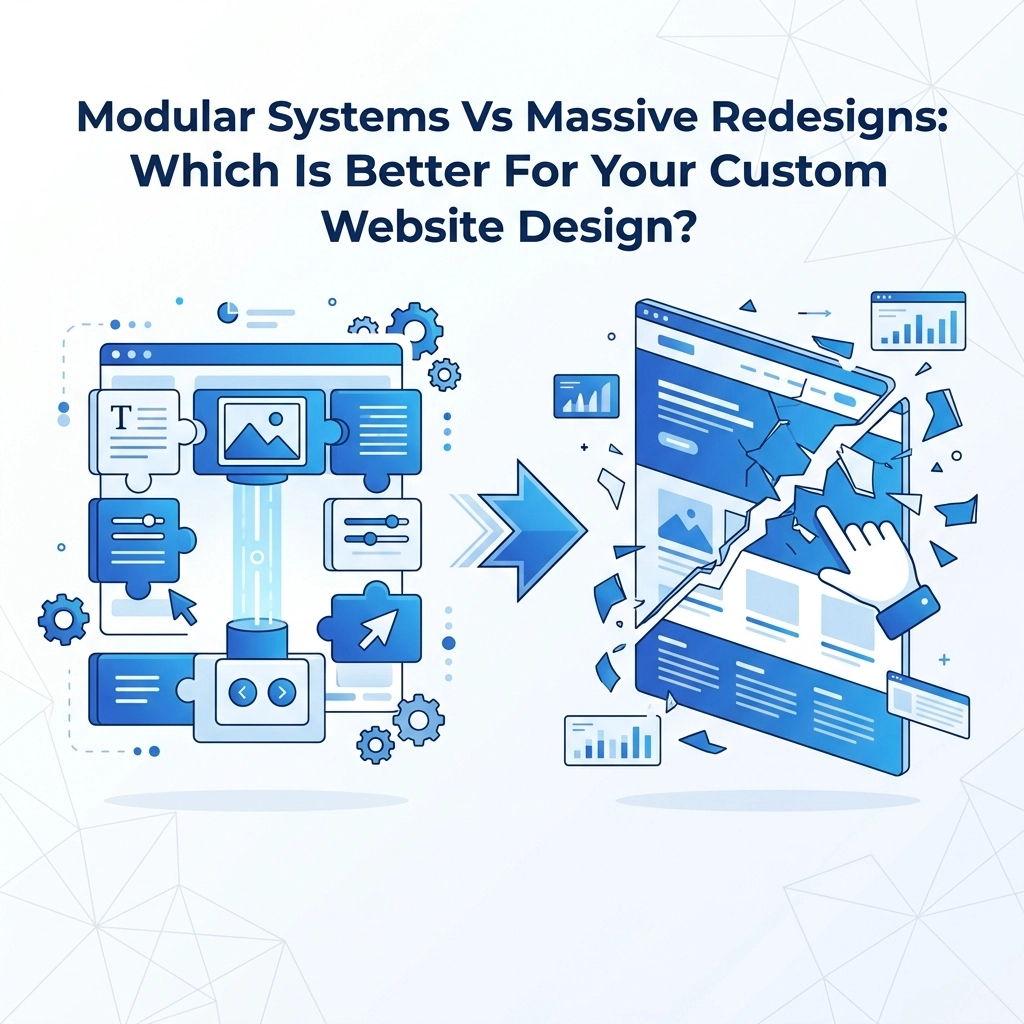

Choosing the right approach for your web presence often feels like a choice between two extremes. You either stick with an aging site until it breaks or you commit to a massive, expensive overhaul that takes months to complete. For years the massive redesign was the industry standard. Businesses would save up their budget for three years and then launch a "new" site that was already becoming obsolete the day it went live. Modern web design has shifted toward modular systems for a reason. These systems provide a foundation that grows with you instead of holding you back
The Problem With The Massive Redesign Cycle
Traditional redesigns follow a predictable but flawed pattern. A company notices their site looks dated or doesn't work on mobile devices. They hire a firm to do a full "ground-up" rebuild. This process usually involves discovery, wireframing, design, development, and testing for every single page type. It takes six months and costs a fortune. By the time the site launches the market has shifted or a new design trend has emerged. Because the site was built as a static monolith making changes later becomes difficult and expensive
This creates a "peak and valley" performance graph. You have a huge spike in engagement after the launch followed by a slow decline for two or three years. During that decline your site stops serving your marketing needs because the structure is too rigid to adapt to new campaigns. You eventually find yourself right back where you started needing another total rebuild

Understanding The Modular System Approach
A modular system treats your website like a collection of components rather than a set of fixed pages. Instead of designing a "Services Page" we design a service header, a feature grid, a testimonial block, and a contact form module. These individual blocks are then stored in a library. When you need a new landing page for a specific campaign you simply stack the blocks you already have in the order that makes sense for that audience
This approach is often called "Atomic Design" or "Component-Based Development" in the professional space. It focuses on the building blocks of the custom website design rather than the final layout of a single page. This gives you several immediate advantages
- Speed to Market: You can launch a core site quickly and add new sections as you go
- Design Consistency: Every module uses the same fonts, colors, and button styles automatically
- Ease of Use: Marketing teams can build new pages without calling a developer for help
- Scalability: Adding a new feature involves building one module not redesigning five pages
Flexibility For Your Marketing Strategy
One of the biggest issues we see with massive redesigns is that they fail to account for future growth. If you decide to launch a new product six months after your big redesign you might find that your site layout doesn't support the content you need. With a modular system you simply create a new module or repurpose an existing one. This flexibility is essential for effective digital strategy because it allows for rapid testing and iteration
If a specific call-to-action block isn't converting well you don't have to redesign the whole page. You can swap that module for a different one and see if performance improves. This turns your website into a living tool rather than a static brochure. We find that companies using modular systems are much more likely to keep their content fresh because the barrier to entry for making updates is so low

Development Speed and Long-Term Maintenance
Building a modular site might take a bit more planning upfront but the long-term payoff is huge. In a traditional redesign the code for various pages is often intertwined. Changing the footer on one page might accidentally break a sidebar on another. Modular systems use isolated code for each block. This makes web and mobile development much cleaner and less prone to bugs
Maintenance also becomes significantly cheaper. When a new web standard emerges or a browser update changes how things are rendered you only have to update the affected modules. You don't have to comb through hundreds of individual pages to fix issues. This efficiency allows your budget to go toward growth and new features instead of just keeping the lights on
Cost Analysis: Initial Investment Vs ROI
At first glance a massive redesign might seem like the cheaper option because you are paying one flat fee for a finished product. However the hidden costs of downtime and the eventual need for another total rebuild make it much more expensive over a five-year period. A modular system is an investment in a platform that lasts
Think of it like this: A massive redesign is like buying a car and driving it until the engine explodes then buying a new car. A modular system is like buying a vehicle where you can easily swap the engine, update the interior, and add new tech as it becomes available. You never have to buy a "new" car because the one you have is always state-of-the-art

How WorldWise Implements Modular Systems
We focus on building websites that solve business problems. Our process starts with identifying the core functions your site needs to perform. We build a robust library of components tailored to your brand. This allows us to get you up and running faster while ensuring you have the tools to expand in the future. We suggest this approach for any business that plans to grow or change their offerings over the next few years
If you are currently looking at your site and wondering if it is time for a change we recommend skipping the "burn it down" approach. Let us look at your current needs and see how a modular transition can save you time and money. You can find more about our specific methods on our about page or by reaching out to our team directly
Choosing What Is Right For You
There are rare cases where a massive redesign makes sense. If your current site is on a completely obsolete platform that cannot be salvaged you might need a clean break. But even in that scenario the "new" site should be built using a modular framework. You want to make sure this is the last "massive redesign" you ever have to do
Consider these questions when making your choice
- How often do you need to add new content or pages?
- Do you have multiple team members who need to edit the site?
- Is your brand likely to evolve in the next 24 months?
- Do you want to pay for a one-time product or a long-term tool?
Most modern businesses will find that the modular approach offers the best balance of professional aesthetics and functional power. It removes the stress of the redesign cycle and puts the control back in your hands. You focus on running your business while your website adapts to support you

Next Steps For Your Web Presence
If you are ready to stop the cycle of rebuilds and starts using a system that works for you we are here to help. Building a custom website is about more than just looking good. It is about creating a platform that converts visitors into customers and adapts to your needs. We invite you to get started with a consultation to see how a modular system can fit your budget and goals
Whether you need a full platform or just want to start adding modular capabilities to your existing site we have the expertise to guide you. Our goal is to make your web presence the strongest asset in your marketing arsenal. Don't wait until your site is completely broken to start thinking about the future. A modular transition is the smartest move you can make for your digital footprint today