
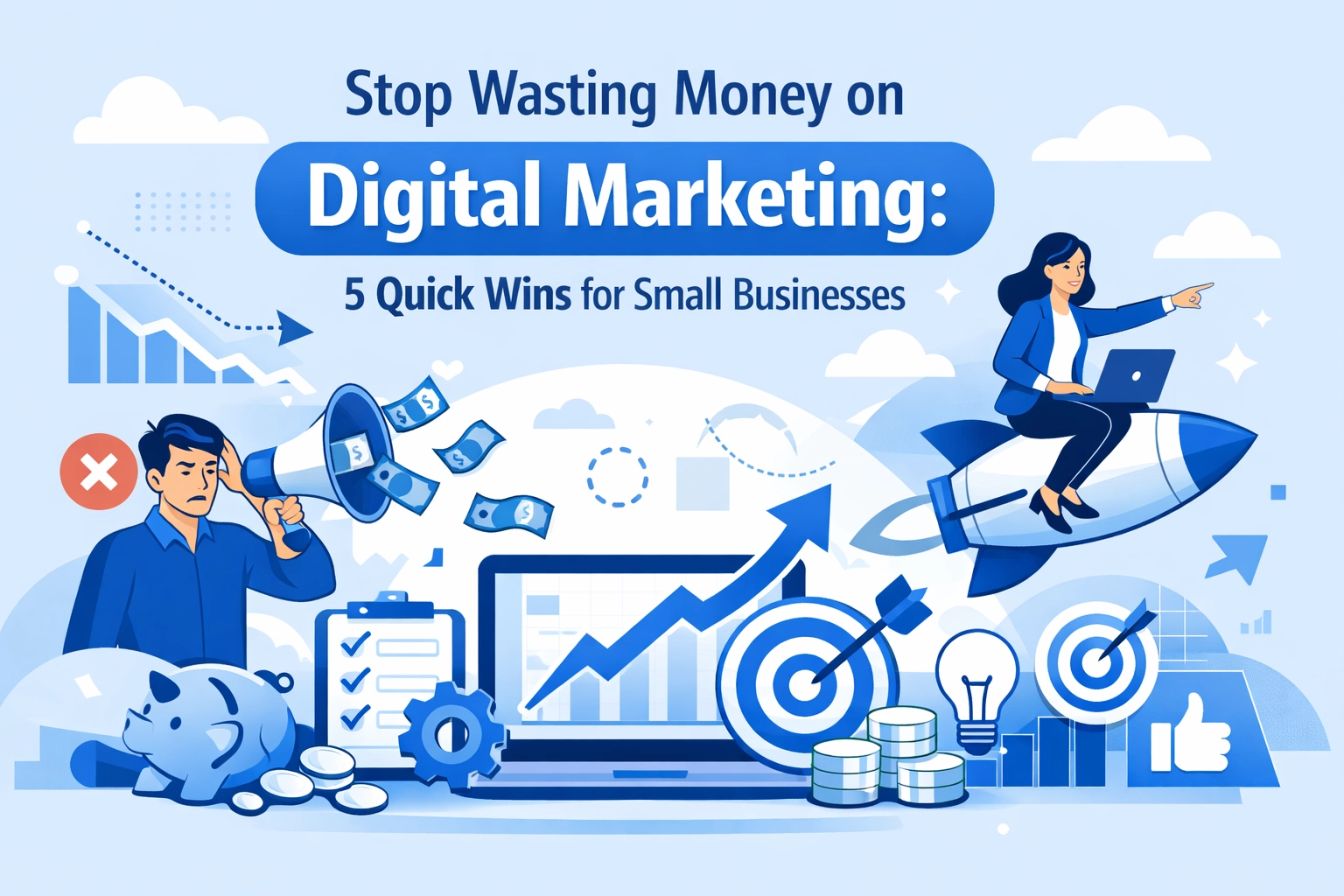

Small businesses waste an alarming amount of their marketing budgets on strategies that don't deliver results. The problem isn't that digital marketing doesn't work: it's that most companies are doing it inefficiently.
Here's a reality check: 37% of marketing spend gets wasted because of poor data quality, and another 35% disappears due to inaccurate targeting. That means nearly three-quarters of your budget might be going nowhere.
The good news? You can turn this around quickly. These five actionable fixes will help you stop bleeding money and start seeing real returns from your digital marketing efforts.
1. Clean and Segment Your Customer Data
Your customer data is either your biggest asset or your biggest liability. Most small businesses treat their contact lists like junk drawers: throwing everything in without organization or maintenance.
Start by analyzing what you've got. Remove duplicates, fix formatting inconsistencies, and delete contacts that haven't engaged in over a year. Then segment your audience based on behavior, purchase history, and engagement level.

Why does this matter? Because sending the same message to everyone is expensive and ineffective. When you segment properly, you can create targeted campaigns that speak directly to specific customer needs. A new customer needs different messaging than someone who's been buying from you for three years.
Better data quality means better targeting. Better targeting means higher conversion rates and lower acquisition costs. It's that simple.
The bonus? Organizing your data more efficiently also reduces the energy costs of storing excessive, useless information on servers. Clean data is cheaper data.
2. Audit Your Marketing Technology Stack
How many software subscriptions are you paying for right now? Go ahead and count them. Now ask yourself: when's the last time you actually logged into each one?
Most small businesses accumulate marketing tools over time without ever canceling the ones they stop using. That $50/month email platform you replaced two years ago? Still charging your credit card. The social media scheduler you tried once? Also still there.
Do a complete audit of your martech stack. List every tool, its monthly cost, and when your team last used it. Be ruthless about cutting what isn't contributing to measurable results.
Focus on tools that do multiple things well rather than specialized tools that only solve one narrow problem. Consolidation saves money and reduces the complexity of managing multiple platforms.
Take the budget you free up and redirect it toward the tools that actually move the needle for your business. Or better yet: invest it in the strategies covered in the rest of this article.
3. Redirect Budget to Your Best-Performing Channels
Here's an uncomfortable question: do you actually know which marketing channels deliver the best ROI for your business?

Most small businesses spread their budget across multiple channels out of habit rather than strategy. They post on six social media platforms because that's what everyone else does. They run ads on three networks because a consultant told them to five years ago.
Stop guessing and start measuring. Analyze your performance data to identify what's actually working. Look beyond vanity metrics like impressions and clicks: focus on conversions, customer lifetime value, and actual revenue generated.
Once you know what works, double down on it. If email marketing generates 60% of your leads but only gets 20% of your budget, that's a problem you can fix today.
Eliminate the channels that consistently underperform. It's okay to abandon platforms that aren't delivering results. Your customers aren't everywhere, and you shouldn't be either.
Calculate the true ROI by considering lifetime value rather than just acquisition costs. A channel might look expensive upfront but could be bringing in your highest-value customers.
4. Automate Repetitive Marketing Tasks
Your team shouldn't be copying and pasting data between systems or manually sending follow-up emails. Every minute spent on repetitive tasks is a minute not spent on strategy and growth.
Marketing automation tools can handle the boring stuff while your team focuses on creative work and strategic decisions. Set up workflows that trigger based on customer behavior: abandoned cart emails, welcome sequences, re-engagement campaigns.

Use platforms like Zapier to connect your different tools and eliminate manual data entry. When someone fills out a contact form, the information should automatically flow into your CRM, email platform, and project management system without anyone touching it.
Automation reduces errors too. Humans make mistakes when doing the same task hundreds of times. Software doesn't.
The initial setup takes time, but the ongoing savings are massive. A properly configured automation workflow can handle work that would otherwise require a full-time employee.
Start small. Pick one repetitive task that drives your team crazy and automate it this week. Once you see the benefits, expand from there.
5. Replace Printed Materials with Digital Alternatives
How much are you spending on business cards, brochures, flyers, and other printed marketing materials? Now consider how many of those materials end up in the trash within minutes of being handed out.
Digital marketing minimizes the need for printed materials while making your content more accessible and measurable. Instead of printing thousands of brochures, create a digital version and use QR codes to direct people to it.
Trade show handouts? Replace them with a QR code that captures contact information and sends attendees everything they need digitally. In-store signage? Use changeable inserts or digital displays instead of printing new materials for every promotion.
Send digital invoices instead of printed receipts. Create email signatures with links to your latest offers instead of including flyers with every shipment.
The environmental benefits are obvious, but the business benefits matter more: digital materials are cheaper to produce, easier to update, and provide data on who's actually engaging with your content. You can see who downloaded your catalog, which pages they spent time on, and whether they converted to a customer.
Plus, you're not stuck with boxes of outdated brochures in your storage room every time your pricing or offerings change.
Stop the Waste and Start Getting Results
These five quick wins aren't theoretical strategies that might work someday. They're practical changes you can implement this month to immediately reduce wasted spending and improve your digital marketing results.
Start with the one that seems easiest for your business. Get that win, then move to the next one. Within 90 days, you'll be operating a leaner, more effective marketing operation that delivers better results with less waste.
Need help implementing these strategies or want a professional audit of your current digital marketing approach? WorldWise specializes in helping small businesses eliminate waste and maximize their marketing ROI. Get in touch and let's find out where your budget is going and how to make every dollar count.