

Your server crashes at 3 PM on a Friday. Your team can't access files. Customers can't complete purchases. You're scrambling to find someone who can fix it.
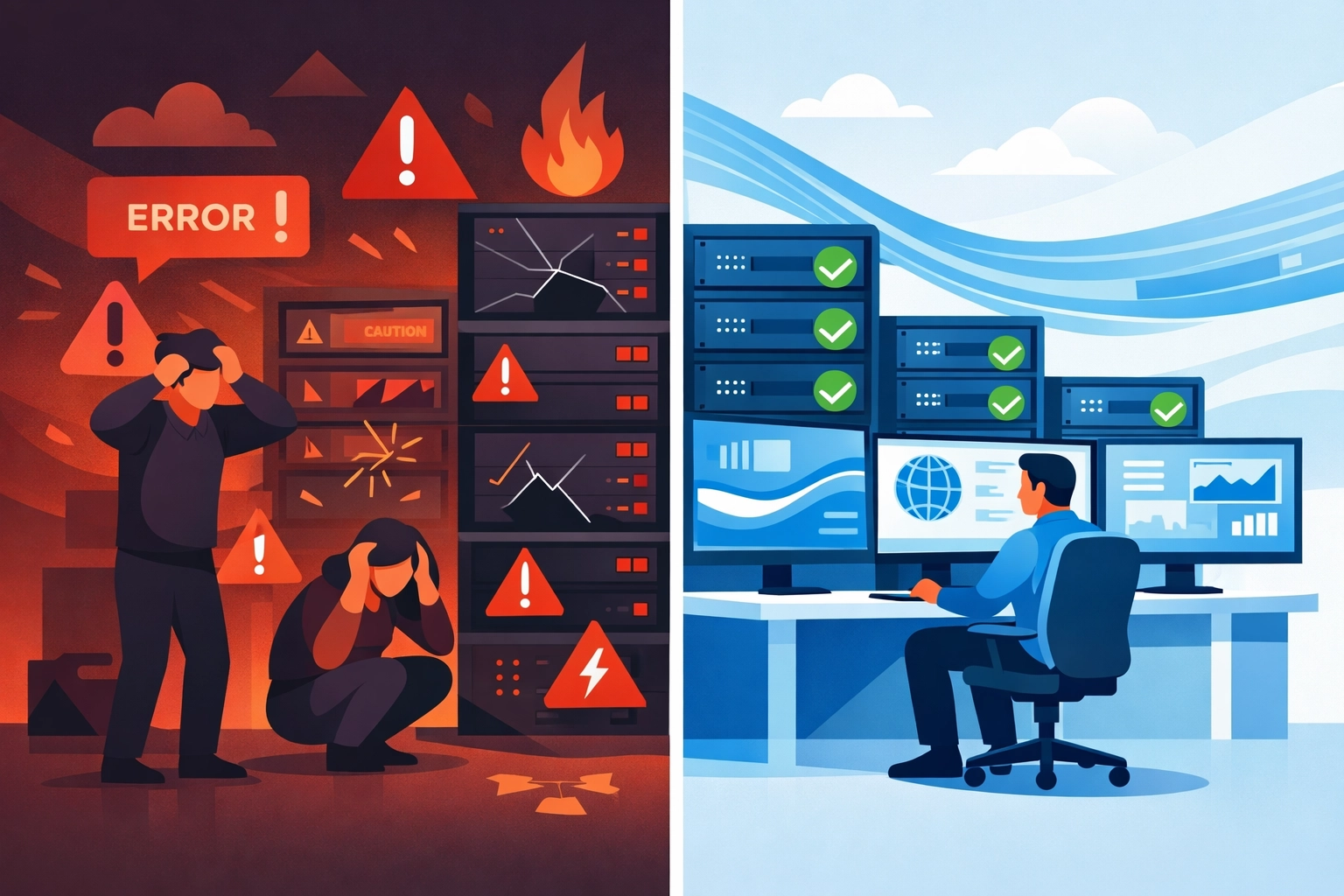
This is the reality of break-fix IT support. You only pay when something breaks, but you also lose revenue, productivity, and peace of mind every time it happens.
There's a better way. Managed IT services flip the script entirely: preventing problems before they start and giving you access to enterprise-level expertise without the enterprise-level price tag.
Let's break down why more businesses are ditching the break-fix model and in-house IT teams in favor of outsourced managed services.
The Hidden Costs of Break-Fix IT
Break-fix sounds affordable on paper. You only pay when something needs fixing, right?
Wrong. The real costs are hidden in downtime, emergency rates, and recurring issues that never get properly resolved.
When your email server goes down, you're not just paying for the repair. You're paying in lost productivity while your team sits idle. You're paying in missed sales opportunities. You're paying in frustrated customers who can't reach you.
Emergency IT rates can hit $200-300 per hour. And because break-fix technicians are incentivized to fix problems quickly rather than prevent them, you'll likely face the same issues again in a few months.
Managed IT services work differently. You pay a predictable monthly fee, and your provider actively monitors your systems to catch issues before they cause downtime. No surprises, no emergency bills, and significantly less downtime overall.
Why In-House IT Teams Can't Keep Up
Building an in-house IT department seems logical until you run the numbers.
A single skilled IT professional costs $60,000-90,000 annually in salary alone. Add benefits, training, equipment, and overhead, and you're looking at $100,000+ per year for one person.
One person can't cover everything. They can't monitor systems 24/7. They can't be an expert in networking, security, cloud services, backup systems, and compliance all at once. And when they take vacation or get sick, you're on your own.
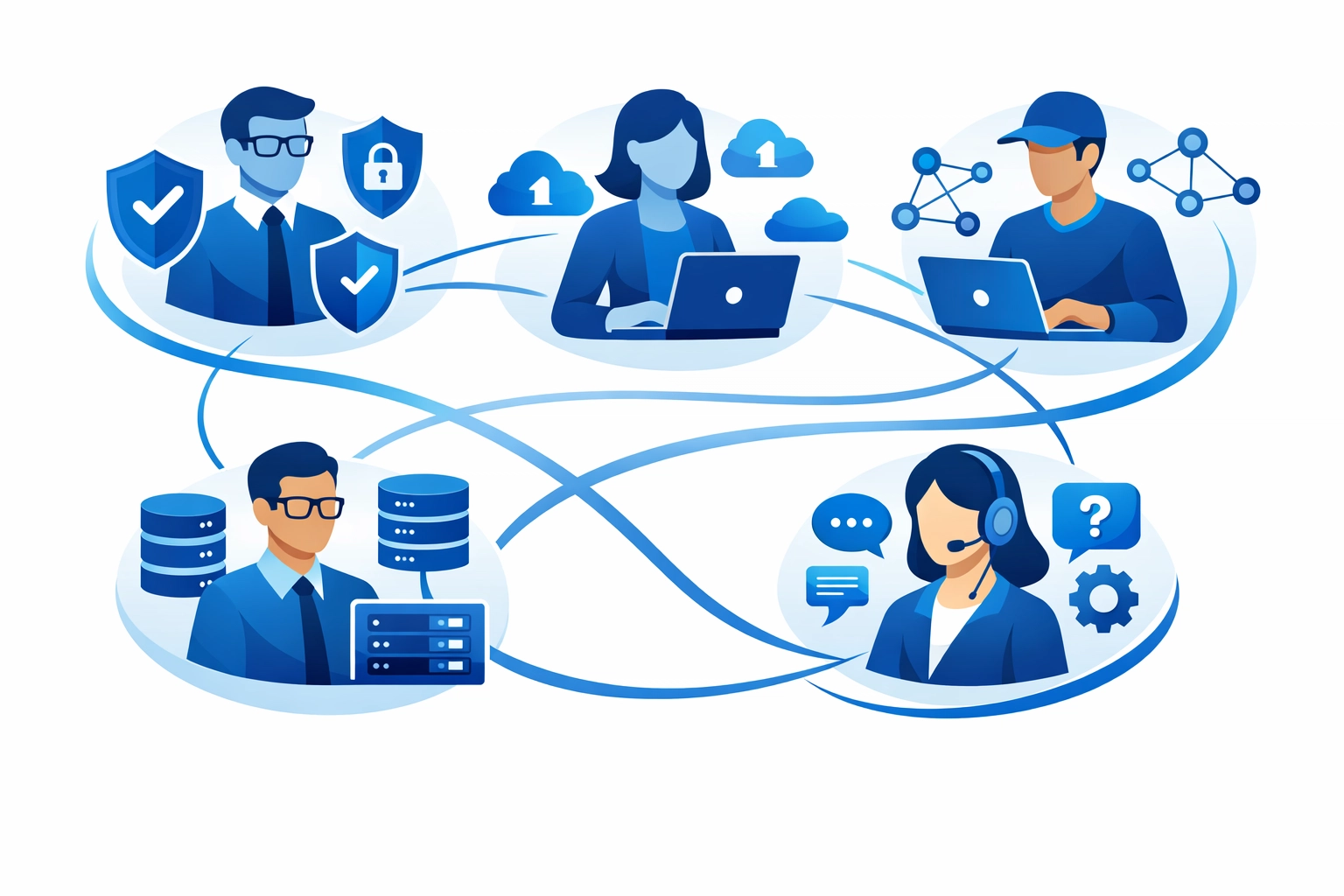
For the same cost as one in-house employee, a managed IT service gives you access to an entire team of specialists. You get network engineers, security experts, cloud architects, and help desk support: all working together to keep your systems running smoothly.
Plus, your in-house person is probably spending half their time on routine tasks like password resets and printer issues instead of strategic projects that actually move your business forward.
Proactive Monitoring Prevents Expensive Disasters
The difference between managed IT and break-fix is like the difference between preventive medicine and emergency room visits.
Managed service providers use sophisticated monitoring tools that track your systems 24/7. They catch warning signs: a hard drive starting to fail, unusual network activity, memory running low: and fix them before they turn into emergencies.
This proactive approach dramatically reduces downtime. Instead of discovering your backup system failed when you actually need it, your MSP identifies the issue weeks earlier and resolves it quietly in the background.
You're not paying for firefighting anymore. You're paying for fire prevention.
The business impact is significant. Research shows that proactive monitoring can reduce downtime by 85% compared to reactive break-fix models. That's hours or even days of productivity your team doesn't lose.
Enterprise-Grade Security Without Enterprise Budgets
Cybersecurity isn't optional anymore. Ransomware attacks, data breaches, and phishing scams target businesses of all sizes.
Building a comprehensive security program in-house requires multiple specialists, expensive tools, and constant vigilance. Most small and mid-sized businesses simply can't afford it.
Managed IT providers spread those costs across multiple clients. You get access to enterprise-grade firewalls, intrusion detection systems, 24/7 security monitoring, and incident response teams: all included in your monthly fee.
Your MSP handles patch management to keep software vulnerabilities closed. They implement multi-factor authentication to prevent unauthorized access. They monitor for suspicious activity and respond to threats in real-time.
They also help you stay compliant with industry regulations like HIPAA, PCI-DSS, or GDPR. Non-compliance penalties can run into hundreds of thousands of dollars. Your managed service provider ensures you're meeting all requirements and maintaining proper documentation.
Learn more about comprehensive cybersecurity solutions that protect your business without breaking your budget.
Scalability That Grows With Your Business
Your IT needs today are different from what they'll be in two years.
With in-house IT, scaling up means hiring more people, buying more equipment, and managing more complexity. Scaling down leaves you stuck with overhead you can't easily reduce.
Managed IT services scale effortlessly. Adding new employees? Your MSP provisions their accounts, devices, and access in hours. Opening a new office? They can set up your infrastructure remotely. Launching a new application? They ensure your network can handle the load.
You're not locked into fixed costs or long-term commitments for infrastructure you might not need next year. Your IT support flexes with your business needs.
This flexibility is particularly valuable for growing companies. You get the technology infrastructure of a much larger organization without the capital investment or management overhead.
Strategic IT Planning vs. Reactive Firefighting
The most overlooked benefit of managed IT is strategic planning.
Break-fix technicians fix what's broken and leave. In-house IT teams are often too busy with daily issues to think strategically. Managed service providers include virtual CIO services that help you align technology with business goals.
Your vCIO works with you to develop a technology roadmap. They identify opportunities to improve efficiency, reduce costs, or better serve customers through technology. They help you budget for upgrades and avoid wasteful spending on tools you don't need.
Instead of technology being a cost center that only gets attention when something breaks, it becomes a competitive advantage that drives growth.
The Real ROI of Managed IT
Let's talk numbers. A typical managed IT service costs $100-200 per user per month depending on your needs and complexity.
For a 20-person company, that's $2,000-4,000 monthly. Sounds like a lot until you compare it to alternatives:
- One in-house IT person: $8,000+ per month (with limited expertise and no backup)
- Break-fix average: $3,000-6,000 per month (with unpredictable spikes and significant downtime)
- Cost of a single ransomware attack: $50,000-200,000+ in ransom, recovery, and lost business
Beyond direct cost savings, managed IT delivers ROI through improved productivity, reduced downtime, better security, and the ability to focus your team on revenue-generating activities instead of technical problems.
Most businesses see a positive return within 6-12 months, often sooner when factoring in avoided disasters.
Making the Switch
Moving to managed IT services doesn't have to be complicated.
A good MSP will assess your current infrastructure, identify immediate risks, and create a transition plan that minimizes disruption. They'll work alongside your existing IT resources during the transition or take over completely if you're coming from a break-fix model.
Look for providers who offer transparent pricing, clear service level agreements, and a proven track record with businesses similar to yours. Ask about their monitoring tools, response times, and how they handle after-hours emergencies.
The conversation should focus on your business goals, not just technical specifications. If they're leading with jargon instead of solutions, keep looking.
Your Technology Should Enable Growth, Not Hold You Back
Technology problems shouldn't wake you up at night or distract you from running your business.
Managed IT services transform technology from a source of stress into a competitive advantage. You get predictable costs, proactive support, enterprise-grade security, and strategic guidance: all without hiring a full IT department.
The question isn't whether you can afford managed IT services. It's whether you can afford not to have them.
Ready to explore how managed IT could work for your business? Check out our services or reach out to discuss your specific needs. Your technology should be working for you, not against you.