
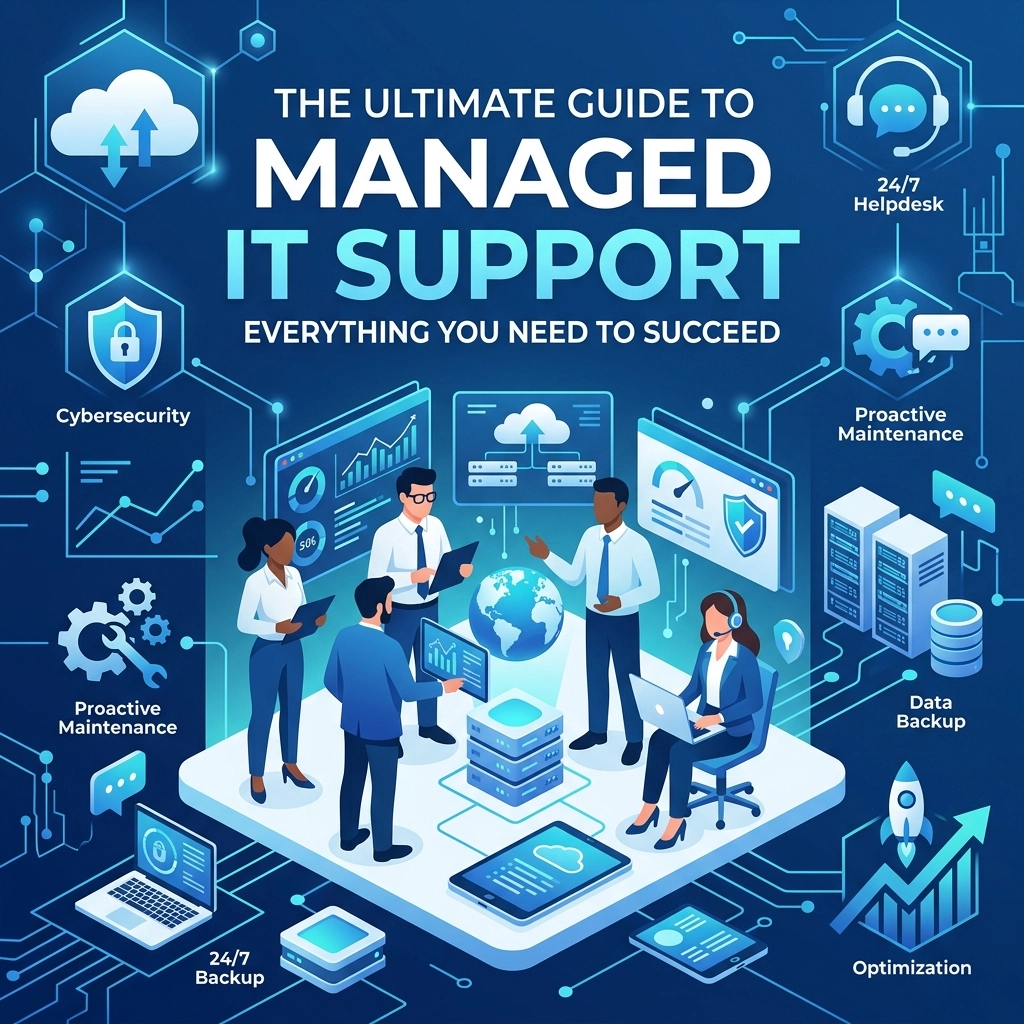

Running a business means dealing with technology every single day. When your network goes down or your email stops working your entire operation grinds to a halt. You cannot afford to wait for a technician to show up three hours late while your employees sit idle and your customers get frustrated. This guide explains how managed IT support changes that dynamic by keeping your systems running before problems even start
What is Managed IT Support
Managed IT support is a service where an external provider takes responsibility for your technology environment. Instead of calling someone only when something breaks you pay a monthly fee for a team to monitor and maintain your systems 24/7. This includes everything from your servers and workstations to your cybersecurity and data backups
This model is often called a Managed Service Provider or MSP. The goal is simple. We want to ensure your technology works so you can focus on your actual job. It moves your IT from a source of stress to a reliable tool that supports your growth

The Problem with the Break-Fix Model
Many small and medium-sized businesses still use the break-fix model. This means you have no one looking at your computers until they stop working. When a failure happens you call a repair person who charges an hourly rate to fix the specific issue. This approach creates several problems for your business
First it is expensive. Hourly rates for emergency repairs are high and you have no way to budget for them. One bad month can wreck your financial projections. Second it creates downtime. By the time you realize there is a problem it is already too late. You have already lost productivity. Third your goals and your IT person's goals are not aligned. They make more money when your stuff breaks. You want your stuff to stay working
Managed IT support aligns these goals. Since you pay a flat monthly fee the provider makes more money when your systems are healthy. They are incentivized to prevent problems rather than just react to them
Core Components of Managed IT Support
To understand how this helps your business you need to know what a standard package looks like. Most agreements cover several key areas that form the foundation of a stable network
Remote Monitoring and Management
We use specialized software to keep an eye on every device on your network. This software alerts us if a hard drive is about to fail or if a server is running too hot. Often we can fix these issues remotely before you even notice anything is wrong. This is the "proactive" part of the service that keeps your business running
Cybersecurity and Threat Protection
Cyber threats are more sophisticated than ever. A basic antivirus program is no longer enough to protect your data. Managed IT support includes advanced firewalls, intrusion detection, and managed antivirus solutions. We handle the updates and patches so your systems are never vulnerable to known exploits. You can learn more about how we handle these technical aspects on our computer support page
Data Backup and Disaster Recovery
If your building floods or a hacker locks your files with ransomware you need a plan. We manage automated backups that store your data both on-site and in the cloud. We do not just set it and forget it. We regularly test these backups to make sure they actually work when you need them. Business continuity is the priority here
Help Desk Support
When your staff has a question or a minor issue they need help fast. Managed support provides a dedicated help desk. Your employees can call or email a technician who can usually remote into their computer and solve the problem in minutes. This keeps your team productive and stops minor tech glitches from turning into half-day ordeals

Key Benefits for Your Business
Switching to a managed model offers several immediate advantages that impact your bottom line and your daily operations
Predictable Monthly Costs
One of the biggest wins is financial clarity. You pay the same amount every month regardless of how many support tickets you open. This makes it easy to plan your budget. You won't get hit with a massive bill because a server decided to quit on a Tuesday morning
Increased Uptime and Productivity
When your systems are monitored and maintained they break less often. This means your employees can actually do the work you hire them to do. Even a 5% increase in uptime can result in thousands of dollars in reclaimed labor costs over a year
Access to Specialized Expertise
Most small businesses cannot afford to hire a full-time Chief Information Officer or a team of cybersecurity experts. When you partner with a provider like WorldWise you get access to an entire team of specialists for a fraction of the cost of one full-time hire. You get enterprise-level expertise without the enterprise-level payroll
Scalability
As your business grows your IT needs change. Adding new employees or opening new locations is much easier with a managed provider. We handle the hardware procurement, software licensing, and network configuration. You just tell us how many people are joining and we make it happen

How to Choose the Right Provider
Not all MSPs are created equal. You need to find a partner that understands your specific industry and your business goals. Here are a few things to look for when evaluating your options
- Response Time Guarantees: Look for a Service Level Agreement or SLA that defines how quickly they will respond to your issues
- Proactive Maintenance: Ask for a list of what they do every month to prevent problems. If they only mention "fixing things" keep looking
- Security Focus: In 2026 security is not an optional add-on. It should be baked into every part of their service
- Strategic Planning: A good provider does more than just fix computers. They should help you build a technology strategy that helps you grow
The Implementation Process
Transitioning to managed IT support is a straightforward process if handled correctly. It usually begins with a comprehensive audit of your current environment. We look at your hardware age, your software versions, and your current security posture
Once the audit is complete we present a plan to bring everything up to standard. This might involve replacing old equipment or migrating services to the cloud. After the initial cleanup we install our monitoring tools and take over the daily management. We also provide training for your staff so they know how to reach the help desk and what to expect from the new system
Common Myths About Managed IT
Some business owners hesitate to switch because of misconceptions about how managed services work
Myth: I will lose control of my data.
Fact: You still own all your data and hardware. We simply manage it for you. You should always have administrative access to your own systems
Myth: It is too expensive for small businesses.
Fact: When you calculate the cost of downtime, data loss, and emergency repairs managed services are almost always more cost-effective than the break-fix model
Myth: My business is too small to be a target.
Fact: Small businesses are actually preferred targets for hackers because they often have weaker security. Managed IT provides the defense you need to stay safe

Taking the Next Step
If you are tired of dealing with computer headaches every week it is time to consider a different approach. Technology should be an asset that drives your business forward rather than a hurdle you have to jump over every day. By outsourcing your IT management you gain peace of mind and a more efficient workplace
Whether you need a full-scale IT overhaul or just someone to keep your servers running we can help. You can view our full capabilities statement to see how we support businesses like yours. If you are ready to stop worrying about your tech and start focusing on your growth reach out to us on our contact page today
Managed IT support is not just about fixing computers. It is about building a foundation for your business to succeed in a digital world. Make the switch and see the difference a proactive team can make for your operations