
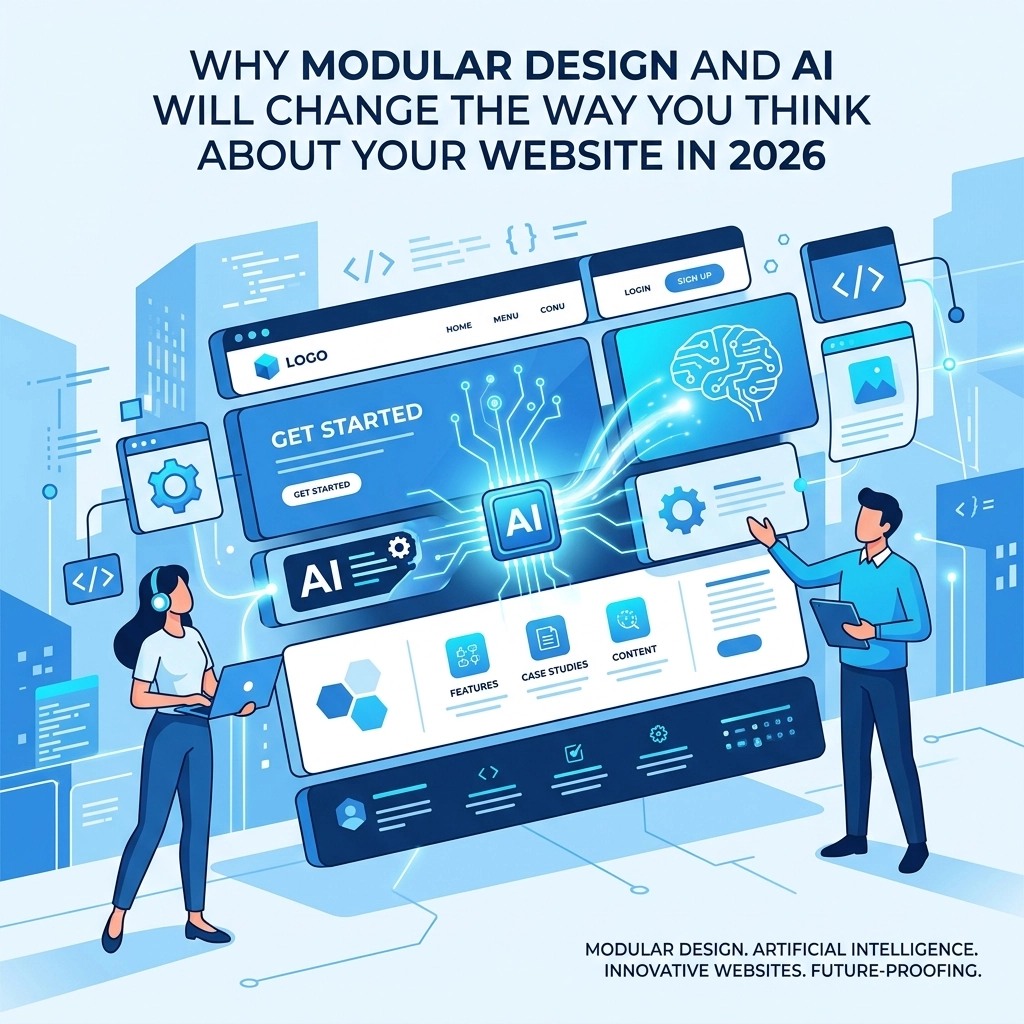

Business owners often treat website redesigns like a massive construction project. You plan for months, launch the site, and then leave it untouched for three years until it feels obsolete. This cycle is expensive and inefficient. In 2026, the industry is moving away from this "static" mindset. The combination of modular design and Artificial Intelligence (AI) is turning websites into living systems that grow and change in real-time.
At WorldWise, we focus on creating digital platforms that don't just sit there. They work. By using modular architecture and intelligent automation, we help businesses build sites that are faster to deploy and easier to optimize over time.
The Problem with Traditional Web Design
Most traditional websites are "monolithic." This means the design and the content are tightly coupled. If you want to change how a specific section looks, you often have to rewrite large portions of the code. This creates a bottleneck. Business owners wait weeks for simple updates, and the cost of maintenance scales poorly.
Traditional sites also struggle with personalization. They serve the same experience to every visitor regardless of why that visitor is there. In a market that demands instant relevance, a generic website is a liability.
What is Modular Design
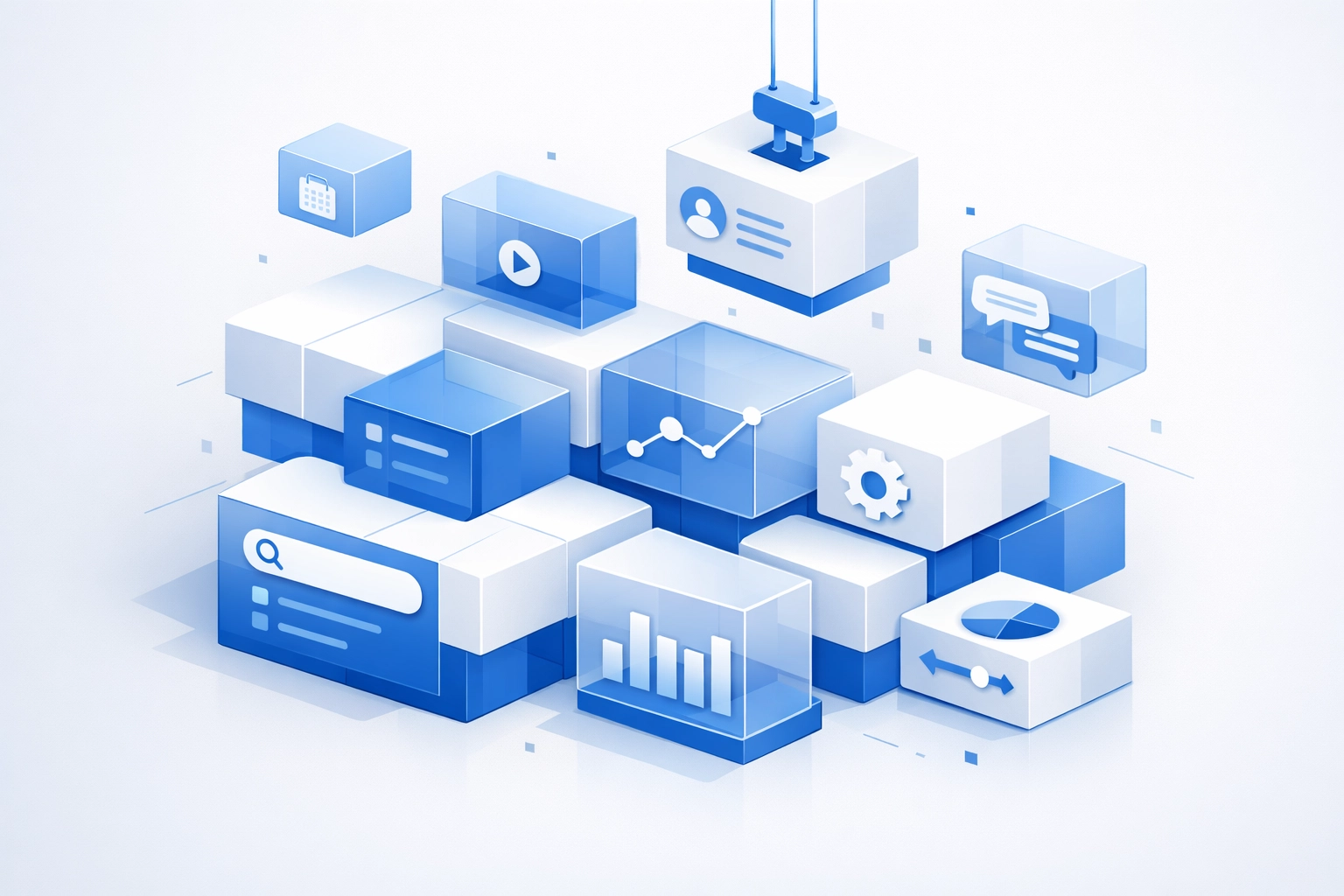
Modular design is a strategy where a website is built using independent, reusable components rather than fixed page templates. Think of it like a set of building blocks. Instead of designing a "Home Page," we design a library of high-performing modules: headers, testimonial sliders, lead capture forms, and product grids.
These modules are designed to work together in any configuration. This approach offers several immediate benefits:
- Faster Launch Times: Once the core module library is built, creating new pages takes hours instead of weeks.
- Consistency: Every part of the site follows the same design system, ensuring a professional look across all devices.
- Lower Long-Term Costs: You only update or fix a module once, and the change reflects everywhere that module is used.
How AI Changes the Modular Game
Modular design provides the structure, but AI provides the intelligence. In 2026, AI is no longer just for generating blog posts. It is the engine that decides how your modular site should behave.
1. AI-Driven Layout Intelligence
AI can now analyze how users interact with your site and suggest layout changes automatically. If data shows that users are missing your primary "Call to Action" because it is too far down the page, an AI-integrated system can swap the positions of your modules to see if a different configuration performs better. This is continuous A/B testing without the manual labor.
2. Predictive User Experience
When a visitor arrives at your site, AI can analyze their referral source, time of day, and past behavior to assemble a custom page on the fly. If a user arrives via a specific marketing campaign, the site can prioritize modules that align with that campaign's message.
For businesses looking to refine their approach, understanding the best marketing strategy for a small business involves this level of technical agility.
Building Faster with AI Scaffolding
From a development perspective, AI is significantly reducing the "grunt work" involved in coding. Our team at WorldWise uses AI-powered tools to generate the initial scaffolding for modular components. This doesn't replace human expertise; it allows our developers to spend more time on complex functionality and security rather than repetitive CSS tasks.
Modular architecture is particularly effective when paired with web and mobile development. It allows for a "write once, use everywhere" mentality. A module designed for the web can be easily adapted for a mobile app or a customer portal because the underlying logic is separated from the visual layer.
The Shift to Living Systems
In 2026, your website should be viewed as a living system. A living system learns from its environment and adapts to survive. A modular, AI-enhanced site does exactly that. It collects data on user clicks, scroll depth, and conversion rates, then uses that data to optimize the interface.
This shift moves web design from a "project" to a "process." At WorldWise, our strategy focuses on this long-term evolution. We don't just hand over a site and walk away. We build systems that are designed to be tweaked and improved every day.
Performance and Speed as a Design Choice
Speed is a critical factor in 2026. Search engines and users have zero tolerance for slow-loading pages. Modular design helps here because it allows for "lazy loading" of specific components. The browser only loads the modules the user needs to see immediately.
AI takes this further by predicting which page a user might click next and pre-loading those specific modules in the background. The result is a browsing experience that feels instantaneous. If your current site feels sluggish, it may be due to an outdated monolithic structure. Transitioning to a modular framework is often the most effective way to improve performance.

Why Custom Design Still Matters
With the rise of AI, some might think that "off-the-shelf" templates are the way to go. This is a mistake. AI is a tool, not a replacement for brand identity and user psychology.
A custom web design ensures that your modular system is built specifically for your business goals. Templates are rigid. If your business grows or changes direction, a template will eventually break. A custom modular system is built to expand. You can add new modules as your services evolve without needing to rebuild the entire site.
Actionable Steps for 2026
If you are looking to update your digital presence this year, consider the following steps:
- Audit Your Current Site: Determine if your site is built on a rigid template or if it has the flexibility of components.
- Prioritize Data: Ensure you are collecting enough data to fuel AI optimization. You can't automate what you don't measure.
- Invest in a Component Library: Instead of a one-off design, ask for a design system that can be reused across all your digital touchpoints.
- Focus on the User Journey: Use AI to identify where users are dropping off and use modular swaps to fix those friction points.
The WorldWise Approach
At WorldWise, we combine high-level technical development with strategic marketing. We understand that a website is a tool for growth. Our expertise in custom website design ensures that your site is not just a digital brochure, but a high-performance engine.
We focus on modular architecture because it gives our clients the best return on investment. It makes your site future-proof. When the next big tech shift happens in 2027 or 2028, a modular site can be updated piece-by-piece, whereas a traditional site will likely need another full redesign.

Summary
The combination of modular design and AI is the most significant shift in web development in a decade. It moves us away from static, disposable websites and toward dynamic, intelligent systems.
This approach allows for:
- Greater Agility: Respond to market changes in hours.
- Better Personalization: Show users exactly what they want to see.
- Higher Efficiency: Spend less on maintenance and more on growth.
If you are ready to stop building websites the old way and start building a platform for the future, we are here to help. You can learn more about our process by visiting our about page or viewing our portfolio to see these principles in action.
Ready to start your next project? Get started today and let’s build something that grows with you.