
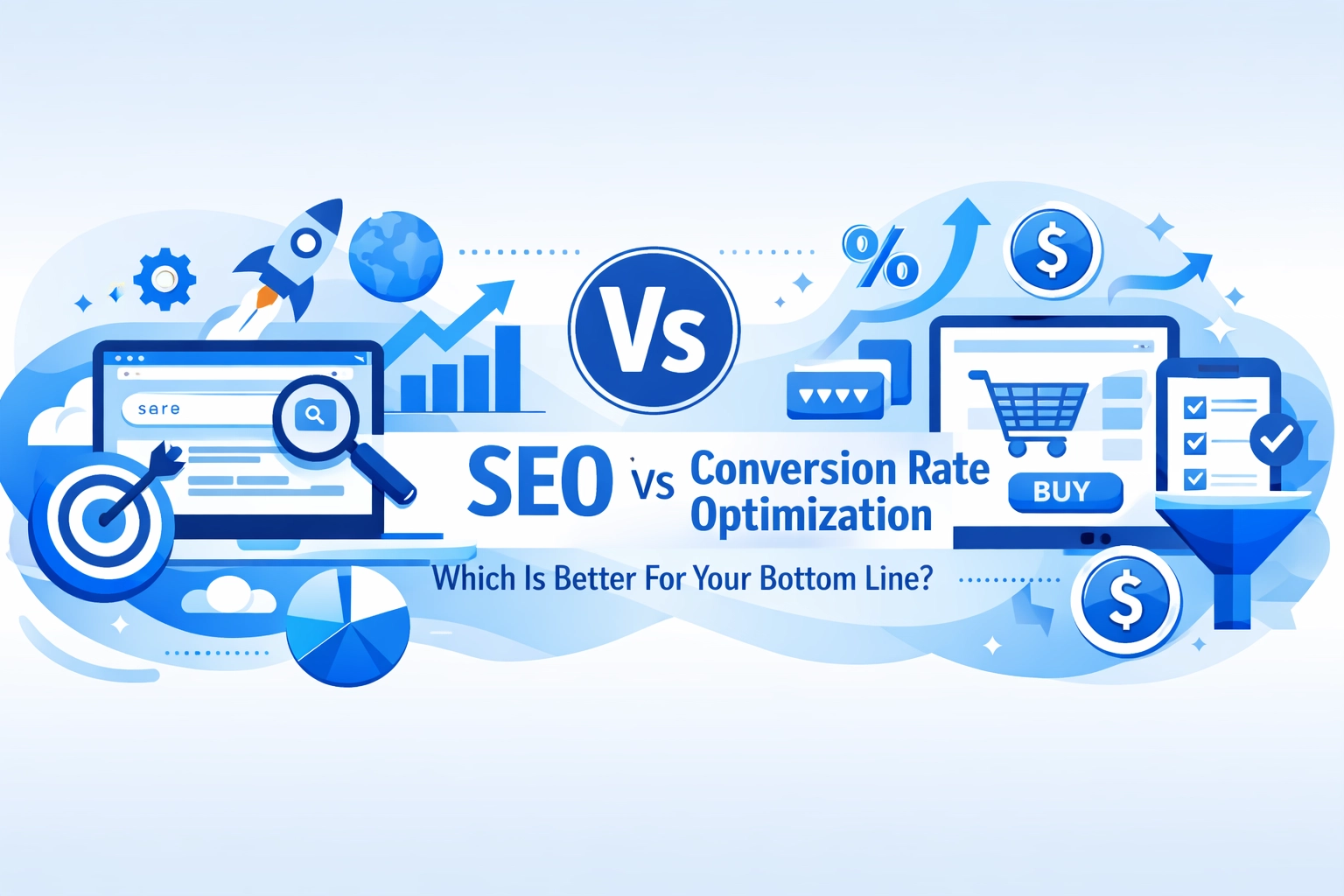

Business owners often ask whether they should spend money on SEO or CRO. They want to know which strategy provides a better return on investment. The reality is that these two disciplines are two sides of the same coin. One brings people to your digital doorstep and the other invites them inside to make a purchase. Choosing between them is like choosing between having a store location or having products on the shelves. You need both to survive in the digital landscape of 2026
Understanding the SEO Engine
Search Engine Optimization is the process of making your website visible to search engines like Google. It involves technical adjustments and content creation. The goal is to rank higher for specific keywords that your customers are searching for. When you rank higher you get more organic traffic. This traffic is valuable because it represents people actively looking for solutions
SEO focuses on factors like site speed and mobile-friendliness. It also looks at backlink profiles and domain authority. A strong SEO strategy ensures that your brand appears when a potential client has a problem. We found high rankings lead to brand trust. People assume that the top result on Google is the most reputable business

The Power of Conversion Rate Optimization
Conversion Rate Optimization is the science of improving the user experience on your site. It starts once the visitor has already arrived. The goal is to get that visitor to take a specific action. This might be filling out a contact form or purchasing a product or signing up for a newsletter
CRO uses data and user feedback to identify friction points. If your checkout process is too long people will leave. If your call-to-action buttons are hard to find people will bounce. By fixing these issues you increase the percentage of visitors who become customers. This makes your existing traffic more profitable without requiring you to find new visitors
Why the Debate Exists
Many marketing teams operate in silos. The SEO team focuses on clicks and impressions. The web design team focuses on aesthetics and functionality. This leads to a conflict of interest. SEO specialists might want long-form text to satisfy search algorithms. Designers might want a minimalist look to improve conversion rates
When these two goals clash the bottom line suffers. You might have a site that ranks number one but converts at zero percent. Or you might have a high-converting landing page that nobody ever sees. This is why a unified marketing strategy is essential for modern business growth

The Multiplier Effect of Alignment
Research shows that combining SEO and CRO leads to significantly better results. Companies that align these disciplines see 30-50% higher conversion rates from their organic traffic. This happens because the content meets the user's search intent perfectly. When a user finds exactly what they were looking for they are more likely to buy
A famous case study involving TokenEx showed a 282% increase in organic traffic and a 500% increase in conversions simultaneously. They did not treat these as separate tasks. They optimized the content for search while making the user journey seamless. This created a multiplicative effect. Instead of just adding results they multiplied them
When to Prioritize SEO
You should prioritize SEO if your website traffic is low. If you have a great product but nobody knows you exist you need visibility. You cannot optimize a conversion rate if you have no visitors to test. Start by building a foundation of quality content and technical health
Check your search console data. If your impressions are low you need better keyword targeting. If your click-through rate is low you need better meta titles and descriptions. SEO is the long game that builds sustainable growth over time. You can learn more about building this foundation at WorldWise

When to Prioritize CRO
Prioritize CRO if you have steady traffic but no sales. High traffic with low conversions is a sign of a broken user journey. We found high bounce rates often indicate that the page does not provide what the user expected. It could also mean your site is difficult to navigate on mobile devices
Look at your analytics. If visitors stay on your site for five minutes but never click "get started" you have a conversion problem. Use heatmaps to see where people are clicking. Simplify your forms. Make your value proposition clear within the first three seconds of a page load. This is often handled during the web design phase
Finding the Middle Ground
The best approach is to treat your website as a living ecosystem. Every SEO update should consider the user experience. Every CRO update should consider search engine rankings. For example if you add a video to a page to increase conversions ensure it is optimized with transcripts for SEO
Don't sacrifice site speed for heavy design elements. Google uses page experience as a ranking factor. This means good CRO is actually good SEO. A site that is easy to use will keep users on the page longer. This signals to Google that your site is high quality. Higher quality leads to better rankings

Technical Strategies for Both
- Improve Page Speed: Fast sites rank better and convert better. Nobody waits for a slow site to load in 2026
- Focus on Mobile: Most searches and purchases happen on phones. Ensure your mobile development is top-tier
- Match Search Intent: Don't just target high-volume keywords. Target keywords that represent a "buying" intent
- Clear Headers: Use H1 and H2 tags that describe the content for robots but also guide the reader's eye
- A/B Testing: Test different versions of your headlines to see which one keeps people on the page longer
Measuring Success Beyond Clicks
Stop looking at traffic as your primary metric for success. Traffic is a vanity metric if it does not lead to revenue. You should measure the organic-to-customer conversion rate. This tells you exactly how much money your SEO efforts are generating
Look at your Customer Acquisition Cost (CAC). If your SEO and CRO are working together your CAC should decrease over time. You are getting more value out of every visitor. This is how you protect your profit margins. We suggest reviewing your strategy quarterly to adjust for changing search trends

The Bottom Line
Neither SEO nor CRO is "better" for your bottom line. They are interdependent. SEO brings the volume and CRO brings the value. If you focus on only one you are leaving money on the table. The most successful businesses in 2026 are those that break down the silos between marketing and design
Start by looking at your data today. Identify if you have a traffic problem or a conversion problem. Then build a plan that addresses both. If you need help identifying these gaps our team can assist. Visit our get started page to begin a conversation about your digital growth
WorldWise provides full-service solutions for businesses looking to scale. We handle everything from web hosting to complex digital marketing campaigns. Our goal is to ensure your website works as hard as you do
Make sure your website is not just a digital business card. It should be a sales tool that attracts and converts 24 hours a day. Balancing SEO and CRO is the only way to achieve that goal in a competitive market