
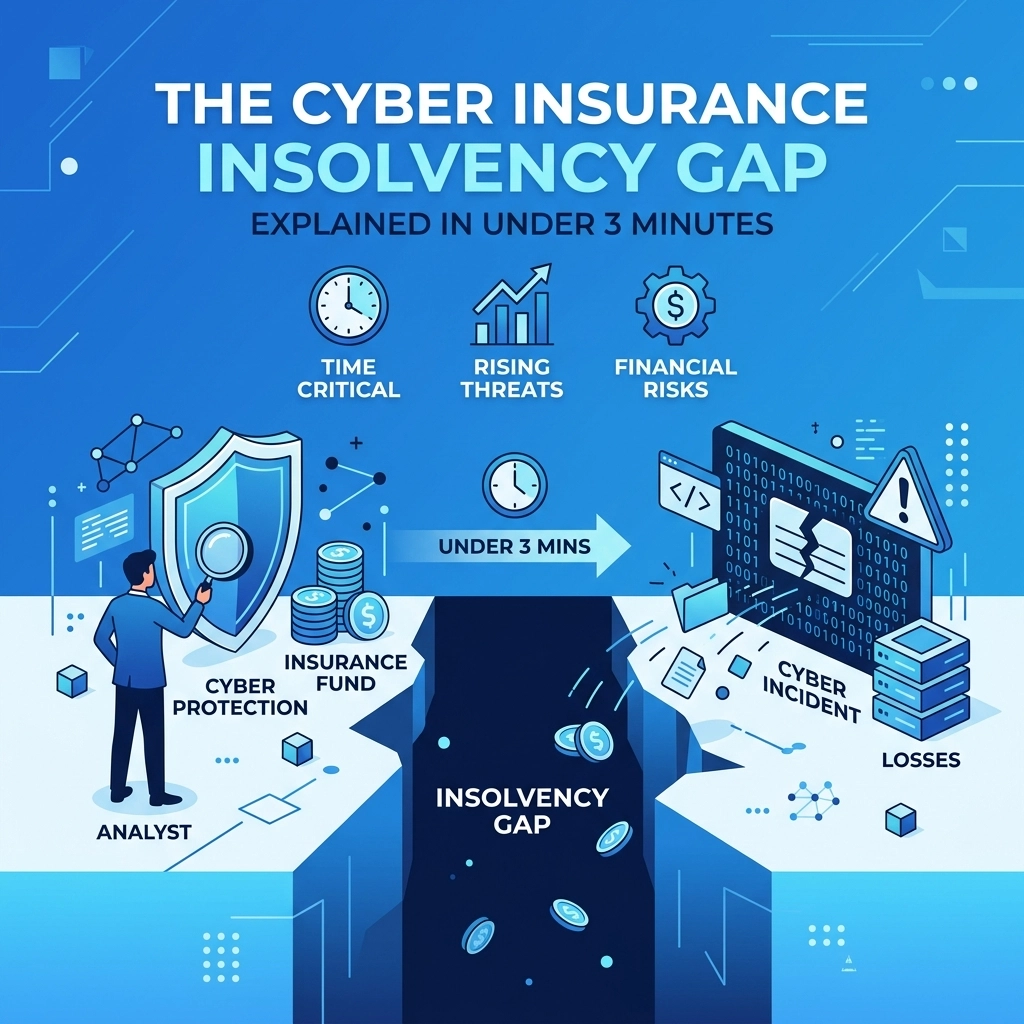

The term Insolvency Gap sounds like corporate jargon found in a high-level accounting textbook but for a small business owner it represents the distance between staying in business and turning off the lights forever. Most business owners assume that if they have a general insurance policy or even a basic cyber rider they are protected against digital threats. The reality is much bleaker.
Data from 2025 and early 2026 shows a massive disconnect between the cash a typical small business keeps on hand and the actual cost of a modern cyberattack. This disconnect is the gap. If the cost of the disaster is higher than your insurance payout plus your available cash you are insolvent.
The Brutal Math of a Breach
To understand the scale of the problem we have to look at the median small business financial profile. The average small business currently holds approximately $12,100 in cash reserves. This is usually enough to cover about 27 days of normal operating expenses. While this feels like a safe buffer for a slow month or a broken piece of equipment it is a drop in the bucket compared to a cyber incident.
In the last year the average cost of a cyber claim for a small business has risen to $264,000. This is a 30% increase from previous years. When you compare $12,100 in the bank to a $264,000 liability you see a gap of over a quarter-million dollars. Unless your insurance policy is specifically designed to cover every penny of that cost your business is effectively a house of cards waiting for a single breeze to knock it down

Why the Gap is Growing
The gap is widening because cybercriminals have realized that small businesses are the "path of least resistance." Large corporations have multi-million dollar security budgets and dedicated teams. Small businesses often rely on outdated plugins, weak passwords, and basic hosting setups that haven't been audited in years.
There are three primary reasons the financial impact is getting worse:
- Sophistication of Ransomware: Attackers no longer just lock your files. They steal data first and threaten to leak it which triggers massive legal and regulatory fines
- Increased Recovery Costs: Specialists who handle digital forensics and data recovery are in high demand and their hourly rates have spiked
- Business Interruption: This is the silent killer. It is not just about the ransom. It is about the two weeks your website is down, your email is offline, and your team cannot process orders
If your digital presence is the heart of your revenue then a website outage is a cardiac event. We often see businesses struggle when their web design and digital marketing efforts are cut short by a security failure that could have been prevented with better strategy
The Underinsurance Trap
A staggering 74% of small businesses are underinsured. This usually happens because the business owner opted for a generic "professional liability" policy that includes a small "cyber add-on." These add-ons often have low limits: sometimes as low as $25,000 or $50,000.
When a $264,000 bill arrives and the insurance company cuts a check for $50,000 you are still on the hook for $214,000. For a business with $12,100 in the bank that is a death sentence. Furthermore 77% of small businesses have no cyber coverage at all. They are operating under the "it won't happen to me" philosophy which is the most expensive gamble a business owner can take

Business Interruption: The 650% Surge
If you think a cyberattack is just about fixing some code or paying a fine think again. The most expensive part of a breach is often Business Interruption (BI). This refers to the income you lose while your operations are paralyzed.
Claims that involve business interruption cost an average of 650% more than claims that only involve data restoration. If your website is your primary lead generator and it goes down you are not just losing the cost of the repair. You are losing every potential client who tried to find you during that window. This is why we emphasize secure web hosting and robust web-mobile development. A stable foundation prevents the downtime that leads to these 650% price hikes
The Three Paths to Failure
When the Insolvency Gap hits a business usually follows one of three paths toward closure:
1. The Ransomware Deadlock
A business is hit with a ransom demand of $50,000. They don't have the cash and their insurance doesn't cover "extortion." They spend three weeks trying to negotiate or rebuild from old backups. By the time they realize they can't recover the customers have moved on to competitors.
2. The Regulatory Nightmare
A breach exposes customer emails or credit card info. Even if the business recovers the data they are hit with legal fees and state-mandated notification costs. These "soft costs" often exceed the actual technical repair costs and drain the remaining cash reserves.
3. The Natural Disaster Overlap
Sometimes a cyber incident coincides with other issues like a natural disaster or a physical hardware failure. Since 40% of small businesses never reopen after a major disaster adding a cyber gap on top of a physical one makes recovery impossible.

How to Close the Gap Immediately
Closing the gap doesn't just mean buying more insurance. It means reducing the likelihood that you will ever need to make a claim. We suggest a two-pronged approach:
Prong One: Risk Transfer
Audit your current insurance policy. If you don't see a "Cyber Liability" section with at least a $500,000 limit you are exposed. Talk to an agent about actual cyber insurance: not just an add-on to your general liability policy.
Prong Two: Risk Mitigation
This is where your technical infrastructure comes in. You need to harden your digital assets so that an attacker chooses an easier target. This includes:
- Using professional computer support to manage patches and updates
- Moving your site to a secure environment that prioritizes uptime and security
- Regularly testing your data backups to ensure they actually work when you need them
Most businesses fail because they treat security as a "later" problem. In 2026 "later" is too late. The Insolvency Gap is a math problem that you can solve today by being proactive about your strategy and your technical safeguards
Your Next Steps
You requested a quick explanation and the takeaway is simple: your cash reserves cannot handle a cyberattack. You must rely on a combination of high-quality insurance and high-quality technical management to stay alive in this environment.
Review your current digital footprint. If your website feels outdated or your hosting is "budget" you are likely increasing your risk profile. We recommend looking at our Capabilities Statement to see how professional oversight can reduce these risks for your business.
Don't let a $264,000 problem destroy a business you spent years building over a gap you can close this week
If you are ready to shore up your digital presence and stop worrying about the "what ifs" then get started with a proper audit of your web assets and security protocols. It is the only way to ensure your business stays on the right side of the gap