
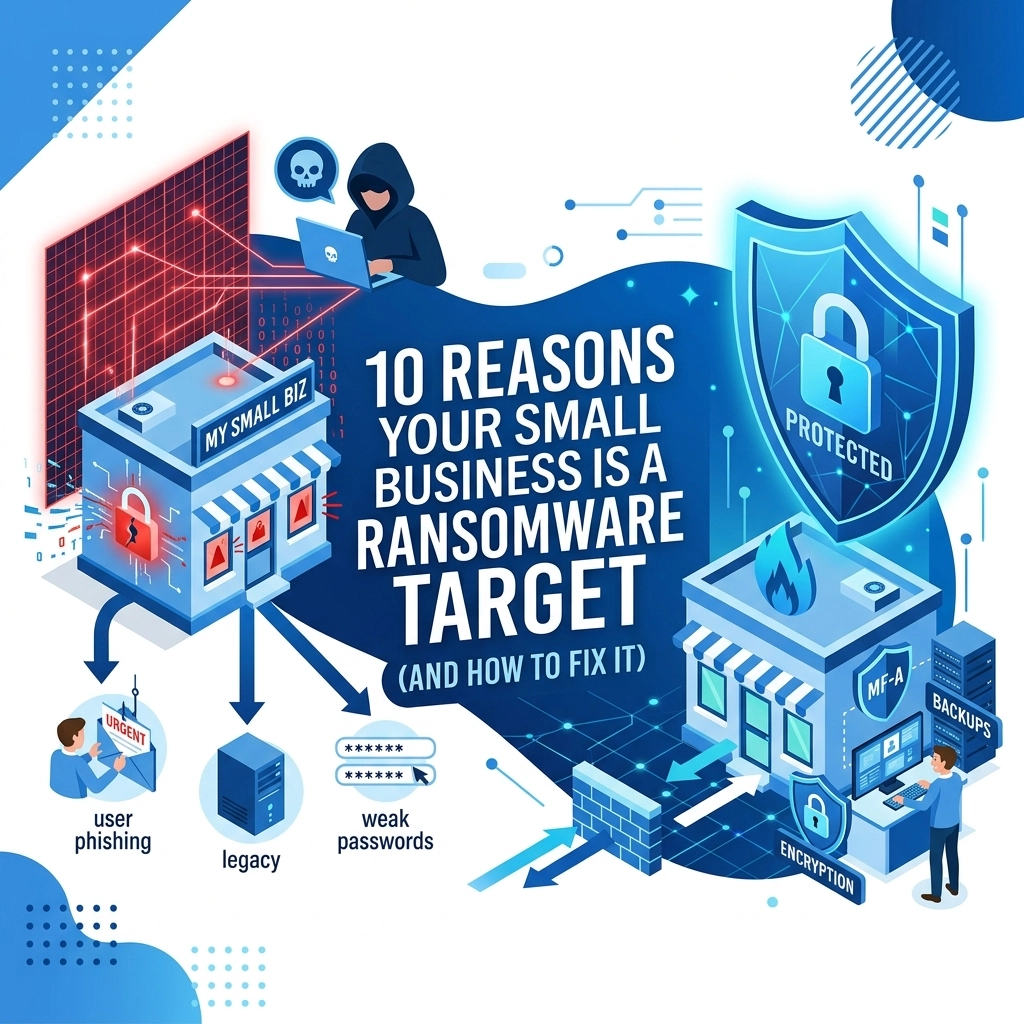

You might think your business is too small to be a target for international hackers. You think they only go after the big fish like banks or global tech firms. This is a dangerous mistake to make. Most ransomware attacks today actually hit small to medium-sized businesses because they are easier to break into.
Hackers use automated bots that scan the internet for weaknesses. These bots do not care about your annual revenue or how many employees you have. They only care if your door is unlocked. If you have a vulnerability, they will find it.
Here are 10 reasons why your small business is currently in the crosshairs and what you can do to protect yourself immediately
1. The "Small Fish" Illusion
Many owners believe their data is not valuable enough to steal. This false sense of security leads to laziness. You skip the updates. You use the same password for everything. Hackers know this. They target you precisely because they know you are not looking for them. To a hacker, 100 small businesses with no security are better than one big corporation with a high-end defense team
How to fix it: Change your mindset. Assume you are a target today. Start by reviewing your current digital footprint and identifying where your data lives.
2. Outdated Software and Systems
Running an old version of Windows or skipping a plugin update on your website is like leaving your keys in the ignition. Software updates often include "patches" for security holes that hackers have already discovered. If you do not update, that hole stays open for anyone to walk through
How to fix it: Turn on automatic updates for everything. This includes your operating system, your web browser, and your website CMS. If you are struggling with keeping your systems current, our team can help with computer support to ensure everything stays up to date

3. Lack of Dedicated IT Expertise
Most small businesses do not have a Chief Information Security Officer. Usually, the "IT person" is just the employee who is the best with computers. This person has a full-time job doing something else. They do not have time to monitor for emerging threats or configure complex firewalls. This leaves massive gaps in your defense that a professional would spot in seconds
How to fix it: Do not DIY your security. Partner with a professional service that understands strategy and long-term protection. You need someone whose job is to watch the perimeter while you run the business
4. Weak Passwords and No MFA
Using "Admin123" or your dog's name is not a security plan. If a hacker guesses your password, they have total control. Multi-Factor Authentication (MFA) is the single most effective way to stop an attack. Even if they have your password, they cannot get in without that second code from your phone
How to fix it: Force a password change for all employees. Require everyone to use a password manager. Most importantly, turn on MFA for every single account you own, especially your email and banking
5. Employee Error and Phishing
Your employees are your greatest asset, but they are also your biggest security risk. One person clicking a link in a fake "FedEx Delivery" email can lock down your entire network. Hackers are getting very good at making these emails look real. They use social engineering to create a sense of urgency so your staff acts without thinking
How to fix it: Run regular training sessions. Show your team examples of real phishing emails. Create a culture where it is okay to ask "Is this real?" before clicking a link. Education is your best firewall

6. No Real-Time Monitoring
Hackers rarely strike the moment they get into your system. They usually sit quietly for weeks. They look for your backups. They find your most sensitive files. They wait for the perfect moment to strike. If you are not monitoring your network traffic, you will never know they are there until the ransom note pops up on your screen
How to fix it: Use security software that monitors for unusual activity. If someone logs in from a foreign country at 3 AM, you need an alert. Regular web hosting with security monitoring can prevent these silent intrusions
7. The Supply Chain Backdoor
You might have decent security, but what about your vendors? Hackers often target a small service provider to get to their larger clients. If you have access to a big client's portal or network, you are a "stepping stone" attack waiting to happen. Your vulnerability puts your best customers at risk
How to fix it: Audit who has access to your systems. Remove any former vendors or employees immediately. Use the principle of "least privilege": only give people access to the exact files they need to do their job
8. Limited Security Budgets
Small businesses often see cybersecurity as an "extra" expense they can cut when times are tough. They would rather spend money on marketing than on a firewall. Hackers count on this. They know you probably haven't invested in the latest encryption or backup tech
How to fix it: Stop looking at security as a cost. Look at it as insurance. The cost of a ransomware payout and the resulting downtime is significantly higher than the cost of prevention. Allocate a specific percentage of your budget to digital defense

9. Lack of Robust Backups
If you get hit with ransomware, your only real choice is to pay the ransom or restore from a backup. If your backups are also encrypted by the hacker, you are in trouble. Many small businesses back up their data to the same network the hackers just took over. This makes the backup useless
How to fix it: Follow the 3-2-1 rule. Have 3 copies of your data. Store them on 2 different types of media. Keep 1 copy completely off-site and disconnected from your main network. Test these backups once a month to make sure they actually work
10. High Pressure to Pay
Hackers know that a small business cannot afford to be offline for a week. You have payroll to meet. You have customers waiting. This desperation makes you more likely to pay the ransom quickly. Hackers prefer a $10,000 payout from you today over a $1,000,000 battle with a giant corporation that could take months
How to fix it: Have an incident response plan. Know exactly who to call the second something feels wrong. Having a plan reduces the panic and helps you make rational decisions instead of desperate ones
Your Action Plan for Today
Security can feel overwhelming. You do not have to fix everything in one hour, but you do need to start. Ignoring the problem is how businesses end up in the news for all the wrong reasons
We suggest starting with these three steps right now:
- Turn on Multi-Factor Authentication for your primary business email
- Verify that your data backup actually finished last night
- Schedule a professional consultation to find the holes in your current setup
Ransomware is a business model for criminals. If you make your business a difficult target, they will move on to someone else who didn't take the time to read this guide. Protect your hard work. Protect your team. Protect your customers

If you aren't sure where to begin, check out our about page to see how we have helped other businesses secure their digital presence. Staying safe in 2026 requires more than just a good password: it requires a partner who understands the landscape
Don't wait until you see a red screen and a countdown timer. The best time to secure your business was yesterday. The second best time is right now
For more information on how to build a secure digital foundation, visit our get started page and let's lock things down together