
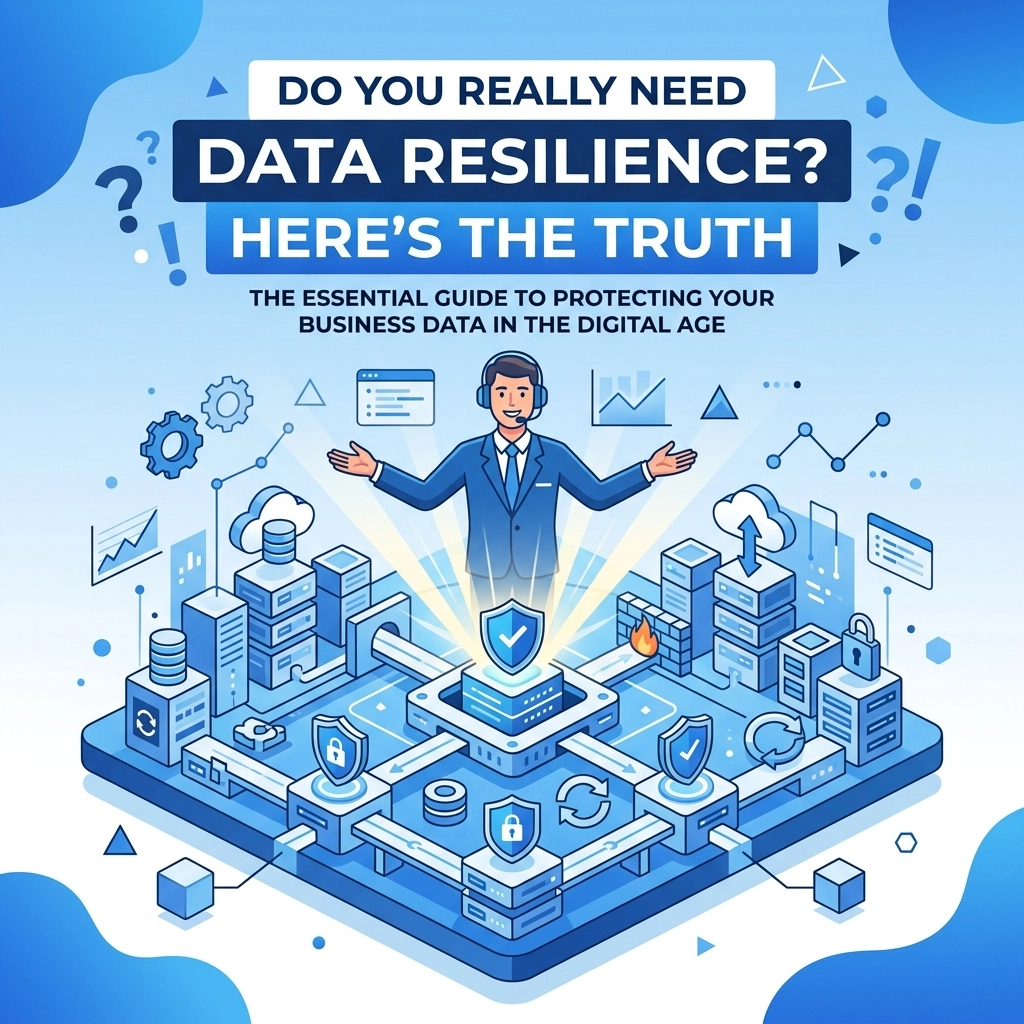

Most business owners think they are safe because they have a backup. They have a hard drive plugged into a server or a cloud subscription syncing their files once a day. They think that if a disaster strikes, they can just "restore" and be back to work in minutes.
The truth is that a backup is just a copy of data. Data resilience is the ability to keep your business running while that data is being attacked, lost, or corrupted. If you are wondering whether you really need to invest in resilience over simple backups, you need to look at the reality of the 2026 digital landscape
The difference between backup and resilience
A backup is a reactive tool. It is a file that sits on a shelf until something goes wrong. If your server dies, you go get the backup and try to put it on a new server. This process takes time, sometimes days or weeks if the hardware is hard to find or the data volume is massive
Data resilience is a proactive strategy. it involves building an infrastructure that can withstand a hit without stopping operations. It includes redundancy, real-time failover, and constant monitoring. Resilience means your business doesn't just "recover" eventually; it stays upright during the storm
If you want to understand how your current systems stack up, check out our computer support services to see the difference between basic maintenance and true resilience
Why the old way doesn't work anymore
In the past, you could afford a few days of downtime. You could tell customers the system was down and they would wait. Today, downtime is a business killer. If your website goes dark or your team can't access client files, your customers will find someone else in seconds
Cybercriminals have also changed their tactics. Modern ransomware doesn't just encrypt your live data; it specifically hunts for your backups first. If your backup is connected to your network, it gets fried along with everything else. Without a resilient strategy like air-gapping or immutable storage, your "backup" is just another useless encrypted file

The hidden cost of downtime
When you ask if you "need" data resilience, you are really asking if you can afford to stop working. Most small business owners underestimate the cost of a single hour of downtime. You have to account for:
- Lost employee productivity (you are paying them to sit around)
- Missed sales opportunities
- Damage to your professional reputation
- Potential legal fees or regulatory fines
For many companies, the cost of one major outage is higher than the annual cost of a managed IT and resilience plan. You are essentially buying insurance for your ability to generate revenue
Data resilience as a competitive advantage
If your competitor gets hit by a virus and is offline for a week while you get hit and stay online, you win. It is that simple. Clients value reliability above almost everything else. When you can prove that your systems are resilient, you build a level of trust that a "standard" business cannot match
We see this often in our web design and strategy work. A fast, beautiful site is great, but a site that is always available regardless of server issues is what actually converts long-term leads
The three pillars of a resilient system
To achieve true data resilience, you need to focus on three specific areas:
1. Redundancy
You should never have a single point of failure. This means having your data in multiple locations. If one data center goes dark, another should automatically pick up the slack. This applies to your web hosting and your internal office files
2. Rapid recovery
Resilience is measured by two metrics: Recovery Point Objective (RPO) and Recovery Time Objective (RTO). RPO is how much data you can afford to lose (e.g., 15 minutes of work vs. 24 hours). RTO is how long it takes to get back online. A resilient system aims for near-zero on both
3. Continuous testing
A plan is only a plan until it is tested. Most businesses find out their backups don't work during an actual emergency. Resilient businesses run "fire drills" to ensure that if a server fails, the failover systems actually trigger as expected

Human error is the biggest threat
We talk a lot about hackers, but the truth is that your own team is your biggest risk. Someone will eventually click a link they shouldn't. Someone will accidentally delete a critical folder. Someone will lose a laptop at an airport
Data resilience accounts for the "human factor." It includes versioning systems that allow you to roll back a single file to how it looked ten minutes ago without restoring the entire server. It includes remote wipe capabilities and strict access controls. You can't stop humans from making mistakes, so you must build a system that makes those mistakes irrelevant
Regulatory and legal requirements
Depending on your industry, data resilience might not be a choice. Laws like GDPR and HIPAA have strict requirements for how data is protected and how quickly it must be restored. If you lose client data and don't have a resilient recovery plan, you could face fines that dwarf the cost of the IT upgrades
You can review our Capabilities Statement to see how we help businesses meet these professional standards
How to start building resilience today
You don't have to overhaul your entire office overnight. You can build resilience in stages:
- Audit your current setup: Know exactly where your data lives and who has access to it
- Implement the 3-2-1-1-0 rule: Three copies of data, two different media types, one offsite, one offline (immutable), and zero errors after testing
- Prioritize your data: Not all data is equal. Figure out what you need to survive the first hour of a crash and protect that first
- Move to managed services: Stop trying to manage IT yourself. Professional computer support ensures that resilience is handled by experts who do this every day

The truth about the investment
Yes, data resilience costs more than a $50 external hard drive from a big-box store. It requires better software, better hardware, and professional oversight. But the "truth" is that the digital world is more dangerous than it was five years ago. Remote work, cloud integration, and sophisticated AI attacks have made basic backups obsolete
If your business relies on digital information to function, you need data resilience. It is the difference between a minor hiccup and a permanent closure
Next steps for your business
Don't wait for a "disk failure" message to appear on your screen. Evaluation of your current risk is the first step toward a more secure future. You can contact us to discuss a strategy that fits your specific needs
Building a resilient business isn't just about technology; it is about peace of mind. When you know your data is safe, you can focus on growing your company instead of worrying about the "what ifs"
If you are ready to get serious about your digital infrastructure, let's look at your strategy and make sure your foundation is solid. The truth is that your data is your business( protect it like it is.)