
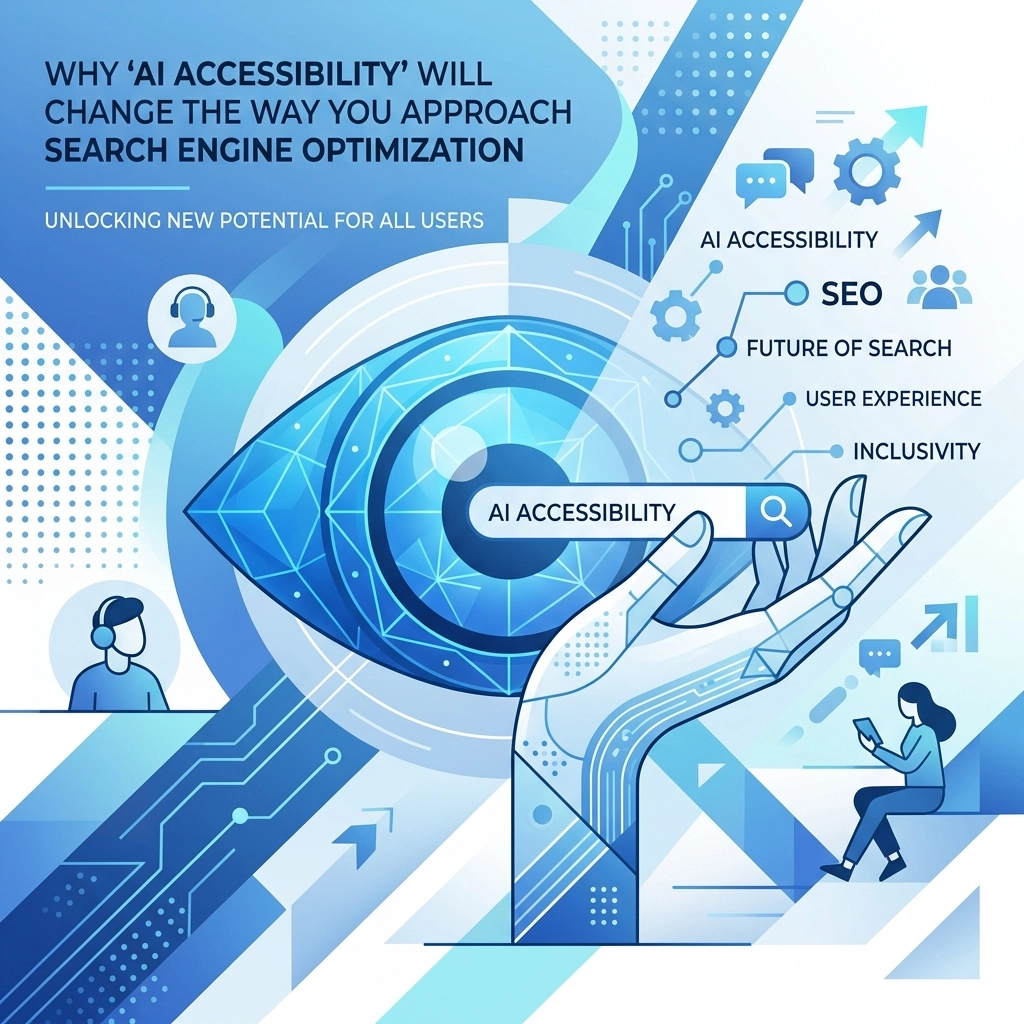

Search engine optimization used to be about keywords and backlinks. You wrote content for people and optimized code for Google bots. Now the landscape has shifted again. AI agents and large language models are the new "visitors" on your site. These machines read content differently than humans. This is where AI accessibility comes in. It is no longer just about compliance for users with disabilities. It is about making your site readable for the AI that determines your search visibility
The Problem with Invisible Content
AI systems like ChatGPT and Google Gemini rely on clear structures to understand context. If your website is a mess of unorganized code, the AI cannot index your value correctly. Many sites use "div soup" which is a bunch of nested containers with no meaning. This confuses screen readers and it confuses AI bots
Action: Audit your site for semantic HTML
You need to use tags like <header>, <main>, <article>, and <section> to define your content. This tells the AI exactly what is important on the page. When an AI summarizes your services, it looks for these landmarks first. If you want better web design that ranks, you must start with the foundation of the code

AI as the New Information Gateway
People are increasingly using AI to find answers instead of clicking through ten blue links on Google. This is often called the "Answer Engine" era. If an AI cannot easily parse your content, you will not be cited as a source. Accessibility features provide the metadata these AI agents crave
Problem: AI cannot "see" images or videos without help
If you have a high-quality infographic but no alt text, the AI ignores it. If you have a video without a transcript, that data is lost to the search index. You are leaving valuable SEO points on the table by ignoring these simple fixes
Action: Implement a strict alt-text and transcript policy
Every image needs a description that explains the "why" and the "what." Every video should have a text-based transcript. This gives the AI more text to analyze and increases the chances of your site being the primary source for an AI-generated answer. Check out our marketing strategies for more on content distribution
Semantic Clarity Improves Discovery
Accessibility and Search Engine Optimization are two sides of the same coin. A study of 10,000 websites found that those with higher accessibility scores saw a 23% increase in organic traffic. This is because search engines reward clarity. AI accessibility takes this further by focusing on machine-readability
Problem: Over-complicated language and poor hierarchy
If your headings are just bold text instead of actual <h1> and <h2> tags, the AI does not know the hierarchy of your information. If you use jargon that an AI cannot link to other concepts, you lose relevance
Action: Simplify your language and fix your headers
Write for a 5th-grade reading level where possible. This makes your content accessible to more humans and easier for AI to translate and summarize. Ensure your heading structure follows a logical path. Do not skip from an H2 to an H4. This confuses the logic of the bot crawling your site

Core Web Vitals and User Experience
Google has confirmed that user experience metrics are a major ranking factor. Accessibility directly impacts these metrics. If a site is hard to navigate with a keyboard, it likely has high bounce rates and low engagement. AI search engines track these signals to determine if a site is "helpful" or not
Problem: Slow, clunky interfaces that fail accessibility tests
Heavily scripted sites that rely on complex JavaScript often break for screen readers and AI crawlers alike. They also load slowly which hurts your Core Web Vitals
Action: Optimize for speed and keyboard navigation
Test your site by navigating it using only the "Tab" key. If you get stuck, an AI crawler might get stuck too. Reducing your reliance on heavy scripts improves both mobile development performance and your SEO standing. A fast, accessible site is a site that ranks well in 2026
The Shift to Voice and Natural Language
AI accessibility is heavily tied to voice search. More people are asking their phones and home assistants questions. These devices use AI to read back the most relevant, accessible snippet of information from the web
Problem: Content not optimized for conversational queries
If your SEO strategy is still focused on "best web design company," you are missing out. People ask "Who is the best web design company for small businesses?" AI looks for direct answers in your text
Action: Create FAQ sections and use Schema markup
Schema markup is a form of microdata that helps AI understand the context of your content. By adding FAQ schema, you make it easy for an AI to pull your answer and read it aloud. This puts you at the top of voice search results. You can see how we handle digital marketing to integrate these technical elements

Future-Proofing Your Digital Presence
The gap between "traditional SEO" and "AI accessibility" is closing fast. In the near future, they will be the same thing. Companies that ignore accessibility will find themselves invisible to the AI agents that consumers use to navigate the internet
Problem: Reactive rather than proactive optimization
Waiting for your rankings to drop before fixing accessibility is a mistake. The AI models are being trained on current data right now
Action: Build accessibility into your workflow from day one
Don't treat accessibility as a final check. It should be part of your strategy from the start. This includes choosing the right hosting and development partners who understand the technical requirements of the modern web
Quick Checklist for AI Accessibility
To ensure your site is ready for the AI search revolution, follow these steps immediately
- Verify all images have descriptive alt text
- Use standard HTML tags for all page elements
- Ensure a logical heading hierarchy (H1 > H2 > H3)
- Add transcripts for all audio and video content
- Implement Schema markup for products, reviews, and FAQs
- Test site speed and fix any Core Web Vital issues
- Ensure the site is fully navigable via keyboard
By focusing on these areas, you improve the experience for human users and make your site a preferred source for AI agents. This is the most effective way to approach search engine optimization in the current year

How WorldWise Can Help
Navigating the intersection of AI and SEO is complex. You need a partner who understands the technical side of web mobile development and the nuances of modern marketing. We focus on building websites that are clean, fast, and fully accessible to both humans and machines
If you are worried that your current site is falling behind in the AI era, it is time for a change. We can analyze your current setup and provide a clear path forward. Our goal is to make sure your business stays visible no matter how search engines change. You can learn more about us or contact us to start your optimization journey today
AI is changing the world of search and accessibility is the key to staying relevant. Do not let your content get lost in the noise because a bot couldn't read your code. Fix your accessibility now and watch your search performance grow