
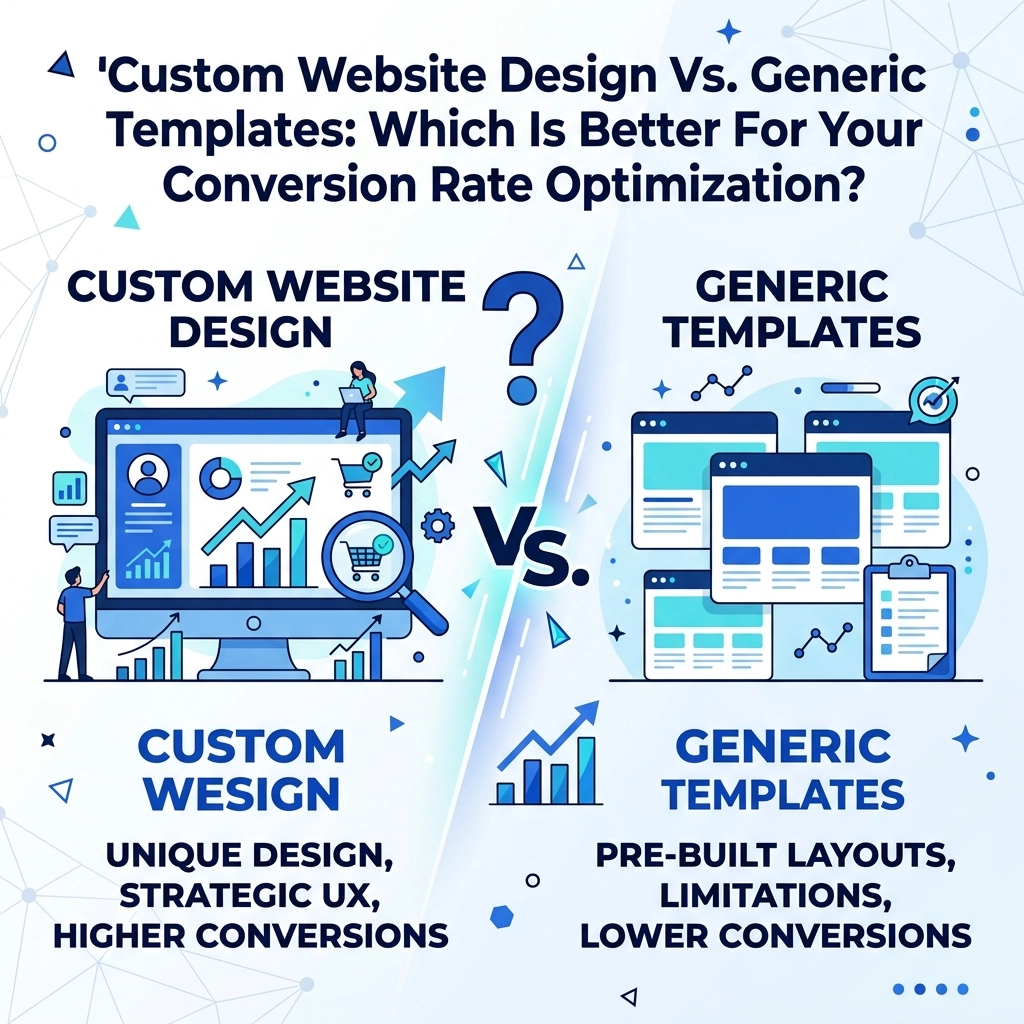

Choosing between a custom website and a generic template is a common hurdle for businesses trying to grow online. Most people look at the upfront price tag and lean toward a template because it seems cheaper. This approach ignores the most important metric for any business: Conversion Rate Optimization (CRO). Your website is a tool to generate leads and sales. If your site does not convert visitors into customers, the initial savings on a template become a massive long-term expense
The Conversion Gap Between Custom and Templates
Data suggests that custom websites consistently outperform templates when it comes to the bottom line. On average, custom-designed sites achieve conversion rates 2 to 5 times higher than template-based sites in the same industry. While a template might convert at 1.2%, a well-executed custom site can push that number to 4.8% or higher. This difference represents a 300% to 400% improvement in lead generation without increasing your advertising spend
Think about the math of your business. If you have 1,000 visitors a month and a template site converts 1% of them, you get 10 leads. If a custom site converts 4%, you get 40 leads from that same traffic. The cost of acquiring those visitors remains the same, but the output quadruples. This is why web design should be viewed as a direct investment in sales capacity
Why Templates Struggle to Convert
Templates are designed to be "good enough" for everyone. Because they are built to sell to thousands of different businesses, they cannot be optimized for any single one. They are rigid and filled with unnecessary code that slows them down
Strategic Misalignment
A template forces your business to fit into a pre-made box. You might have a specific sales process or a unique value proposition that requires a certain visual flow. In a template, you are stuck with where the buttons are and how the text is laid out. This creates friction for the user. If the user journey is clunky or doesn't answer their specific questions at the right moment, they leave. Generic layouts result in generic results
Performance and Technical Debt
Templates often come bloated with "features" you will never use. These extra scripts and styles slow down your page load speed. Studies show that a site taking 6.2 seconds to load can see its bounce rate drop by 50% if that load time is cut to 1.4 seconds. Most templates cannot reach these high-performance speeds because the underlying foundation is too heavy. A custom build removes all the "fat" and focuses only on what makes your site fast and functional

How Custom Design Drives Higher ROI
Custom design is built from the ground up based on your specific business goals. We look at your target audience, their pain points, and what triggers them to take action. This creates a strategic advantage that a $50 template simply cannot provide
Tailored User Journeys
With a custom site, every pixel serves a purpose. We design the strategy around your customer’s psychology. If your customers need to see social proof before they trust you, we place testimonials at the exact point of peak hesitation. If they need technical specs, we present them in a way that doesn't overwhelm the sales pitch. This reduction in friction is what leads to higher conversion rates
Brand Authority and Trust
First impressions happen in milliseconds. A generic template looks like a generic template. Modern consumers are savvy; they can tell when a business has "cut corners" on their digital presence. A custom design establishes immediate authority. It shows you are a serious player in your industry. Trust is a primary driver of conversion. If a user doesn't trust the look of your site, they won't give you their credit card information or contact details

The True Cost of Leads
The most telling metric in the custom vs. template debate is the Cost Per Lead (CPL). Research into digital marketing performance shows a stark contrast:
- Template site average CPL: $425
- Custom site average CPL: $182
By investing in a custom site, you can reduce your customer acquisition costs by up to 57%. This happens because the custom site is better at "closing" the traffic you are already paying for through SEO or paid ads. When your site is optimized, every dollar you spend on marketing goes further
Long-term Maintenance vs. Upfront Investment
Many business owners worry about the higher upfront cost of custom work. However, templates have hidden long-term costs. Because templates are built on third-party frameworks, they often break when those frameworks update. On average, businesses using templates find they have to rebuild or significantly overhaul their site 2.5 times every five years to keep up with technology and scaling needs
A custom website is built to be scalable. It uses a clean foundation that allows for incremental updates rather than total rebuilds. When you look at a five-year window, the total cost of ownership for a custom site is often comparable to a template site, but the custom site has generated significantly more revenue in that same timeframe

SEO and Organic Conversion
Conversion starts with getting the right people to your site. Custom websites offer superior SEO capabilities because the code is clean and the architecture is logical for search engine crawlers. Templates often have "messy" code that makes it harder for Google to understand the content. When your site ranks higher for relevant terms, you attract higher-quality traffic. High-quality traffic converts at a much higher rate than random visitors, further boosting your CRO
The ROI Timeline
What should you expect when moving to a custom design? The results typically follow a specific pattern:
- Months 1-3: The site is launched and indexed. You will see immediate improvements in "on-page" metrics like bounce rate and time-on-site
- Months 3-6: Lead volume typically increases by 50% to 100% as the strategic design begins to take hold of the existing traffic
- Months 6-12: Conversion rates stabilize at 2x to 3x the previous baseline. The ROI becomes clearly positive as the lower cost-per-lead offsets the initial build cost
- Year 1 and Beyond: Compounding returns. Some firms have reported over 2,000% ROI in their first year after switching from a template to a high-performance custom build

Which One Should You Choose?
There are very few cases where a template is the better choice for a growing business. If you are a brand-new startup with a $500 total budget and just need a digital business card, a template might get you through the first month. However, if you are an established business looking to grow, a template is a bottleneck
Choose a Template if:
- You have no budget for marketing or growth
- You do not care about how many leads you get
- You are testing a concept for a few weeks and plan to throw it away
Choose Custom Design if:
- You want to maximize the return on your marketing spend
- You need a site that loads fast and works perfectly on mobile
- You want to stand out from your competitors
- You view your website as a sales tool rather than an expense

How to Get Started
If your current website feels like it is holding you back, it probably is. A site that looks "okay" but doesn't convert is costing you money every single day in the form of lost opportunities. The transition to a custom, high-converting site starts with a clear look at your current data and your future goals
We suggest reviewing your current conversion rates. If you are seeing less than 2%, you have a massive opportunity for growth. You can explore our portfolio to see how custom architecture has transformed other businesses or get started with a consultation to map out a site built specifically for your conversion goals
Stop settling for generic layouts that produce generic results. Your business is unique, and your website should reflect that while driving the leads you need to scale. Investing in a custom build is the most effective way to lower your lead costs and increase your overall revenue without needing more traffic