
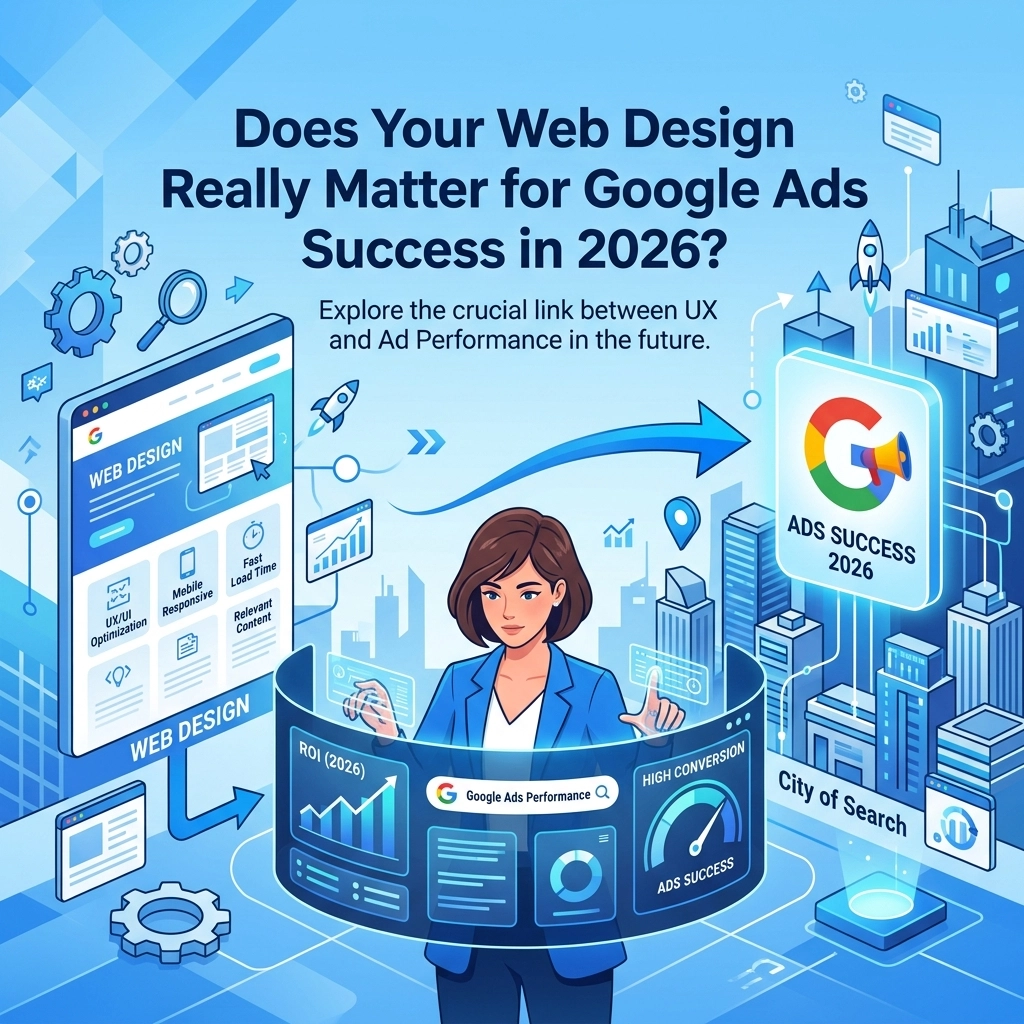

Many business owners treat Google Ads and web design as two separate departments. You might think that once you pay for the click, the hard part is over. In 2026, this mindset will cost you a significant amount of money. The reality is that your web design is the single most important factor in determining your return on investment (ROI). If your website is outdated or slow, you are essentially paying a "bad design tax" on every single click
The hidden cost of poor landing pages
Google does not just look at your bid amount when deciding where to place your ad. They look at your Quality Score. A major component of this score is "Landing Page Experience." If a user clicks your ad and immediately leaves because the page is ugly or confusing, Google notices. They will lower your Quality Score and charge you more per click to maintain your position. Poor design makes your marketing more expensive
When your website is professionally designed, your Quality Score improves. This leads to lower costs per click (CPC) and better ad placements. You can find more about how we handle this at WorldWise
The interaction to next paint (INP) standard
By 2026, speed is no longer just about how fast a page loads. Google now prioritizes Interaction to Next Paint (INP). This metric measures how quickly your site responds when a user actually does something, like clicking a button or opening a menu. If your design uses heavy, unoptimized scripts, the site will feel "heavy" to the user
Users in 2026 have zero patience for lag. If they click a "Get Started" button and nothing happens for half a second, they assume the site is broken. They hit the back button and click on your competitor’s ad instead. You just paid for a click that resulted in zero engagement. Improving your site responsiveness is a direct way to increase your ad success
Mobile-first is now mobile-only
Almost all Google Ads traffic in 2026 comes from mobile devices. If your mobile design is just a "shrunken down" version of your desktop site, your ads will fail. A successful mobile design requires large tap targets, vertical content flows, and thumb-friendly navigation. Users should be able to navigate your entire conversion path using only one hand
We often see businesses spending thousands on ads while their mobile checkout process is a nightmare. If a user has to pinch and zoom to fill out a contact form, they will quit. We recommend reviewing our web design services to see how modern mobile interfaces should function
From static forms to interactive hubs
The days of a simple "Name and Email" form are over. In 2026, high-converting landing pages function as interactive hubs. They use tools like:
- Real-time price calculators
- Instant quote generators
- Interactive product configurators
- AI-driven chatbots that answer specific questions
These elements keep users on the page longer. When a user spends three minutes playing with a calculator on your site, Google sees that as a highly successful interaction. This boosts your ranking and lowers your costs. More importantly, it builds trust with the user. They feel like they are getting value before they even talk to a salesperson
Semantic structure and AI search
Google Ads are increasingly integrated with AI Overviews. If your website code is messy, Google’s AI cannot understand what you are offering. Your design must use clean, semantic HTML. This tells the AI exactly what your headers, prices, and services are. When the AI can easily parse your site, it can better match your ads to highly relevant search queries
If your site structure is outdated, you might be showing up for the wrong keywords. This leads to wasted spend. Proper web and mobile development ensures that your site speaks the same language as the search engine algorithms

The three-second trust rule
In 2026, you have approximately three seconds to prove your business is legitimate. Digital literacy is at an all-time high. Users can spot a template-based, "cheap" website instantly. If your design looks like it belongs in 2015, users will not trust you with their credit card information or personal data
Professional design serves as an immediate trust signal. It shows you are an established business that invests in its own image. Trust indicators like clear logos, professional photography, and intuitive layouts are not just "nice to have" features. They are functional requirements for conversion. You can see examples of high-trust designs in our portfolio
Accessibility as a performance metric
Accessibility is no longer just about compliance. It is about performance. Accessible websites are naturally faster and easier for search engines to crawl. They also cater to a wider audience. If your landing page isn't accessible, you are effectively blocking a portion of the population from using your services. This lowers your total addressable market and hurts your ad efficiency. Google rewards sites that follow universal design principles because they provide a better experience for everyone
Conversion rate optimization (CRO)
Your website's design should be built around a single "North Star" goal. Whether that is a phone call, a form submission, or a purchase, every design element must lead the user there. This is known as Conversion Rate Optimization.
If your Google Ads are bringing in traffic but your sales are flat, your design is the bottleneck. Small changes like the color of a button, the placement of a testimonial, or the length of a form can double your conversion rate overnight. Doubling your conversion rate effectively cuts your ad costs in half. This is why we focus so heavily on the best marketing strategy for a small business

The role of visual hierarchy
Visual hierarchy is the arrangement of elements in a way that implies importance. In 2026, people do not read websites; they scan them. Your design must guide the eye to the most important information first.
- The Headline: What do you do?
- The Sub-headline: Why should I care?
- The Visual: Show me the result
- The CTA: What do I do next?
If these elements are competing for attention, the user will get overwhelmed. A clean, minimalist design with plenty of white space allows your message to stand out. Crowded designs lead to high bounce rates and wasted ad dollars
Integrating AI personalization
Modern web design allows for dynamic content. This means your website can change based on who is clicking the ad. If someone clicks an ad for "Residential Services," the website should show residential images and copy. If the next person clicks an ad for "Commercial Services," the same page can dynamically swap the content to match. This level of personalization is expected in 2026. It makes the user feel like they have found exactly what they were looking for, which significantly increases the likelihood of a sale
How to audit your current design
If you are unsure if your design is hurting your Google Ads, ask yourself these questions:
- Does the page load and become interactive in under two seconds?
- Can I complete a purchase or fill out a form using only my thumb on a phone?
- Is the "Call to Action" visible without scrolling?
- Does the page look professional and modern?
- Is there a clear "next step" for the user to take?
If the answer to any of these is "no," you are losing money on Google Ads every single day. The cost of a website redesign is often much lower than the cost of wasted ad spend over a six-month period

Designing for the future
The digital landscape moves fast. What worked in 2024 will not work in 2026. Your website needs to be a living asset that evolves with technology. This includes keeping up with new web hosting standards and security protocols. A secure, fast, and well-designed site is the foundation of every successful marketing campaign
Stop thinking of your website as a digital brochure. It is your most important salesperson. If your salesperson was turning away customers at the door, you would fire them. If your website is turning away ad traffic, it is time for a change
To get your digital strategy back on track, you can get started here or reach out to us for a consultation. We help businesses align their design with their marketing goals to ensure every dollar spent on Google Ads actually produces a result
Action steps for 2026
Success in 2026 requires a unified approach. Don't let a poor website ruin a great ad campaign. Fix the landing page first, then scale the budget.
- Prioritize INP over simple load times
- Use dynamic, AI-ready semantic layouts
- Implement interactive elements to drive engagement
- Verify that your mobile experience is flawless
If you need help identifying why your ads aren't converting, our team can look at your strategy and provide a clear path forward. Design is not just about aesthetics; it is about the bottom line. Make sure yours is working for you, not against you