
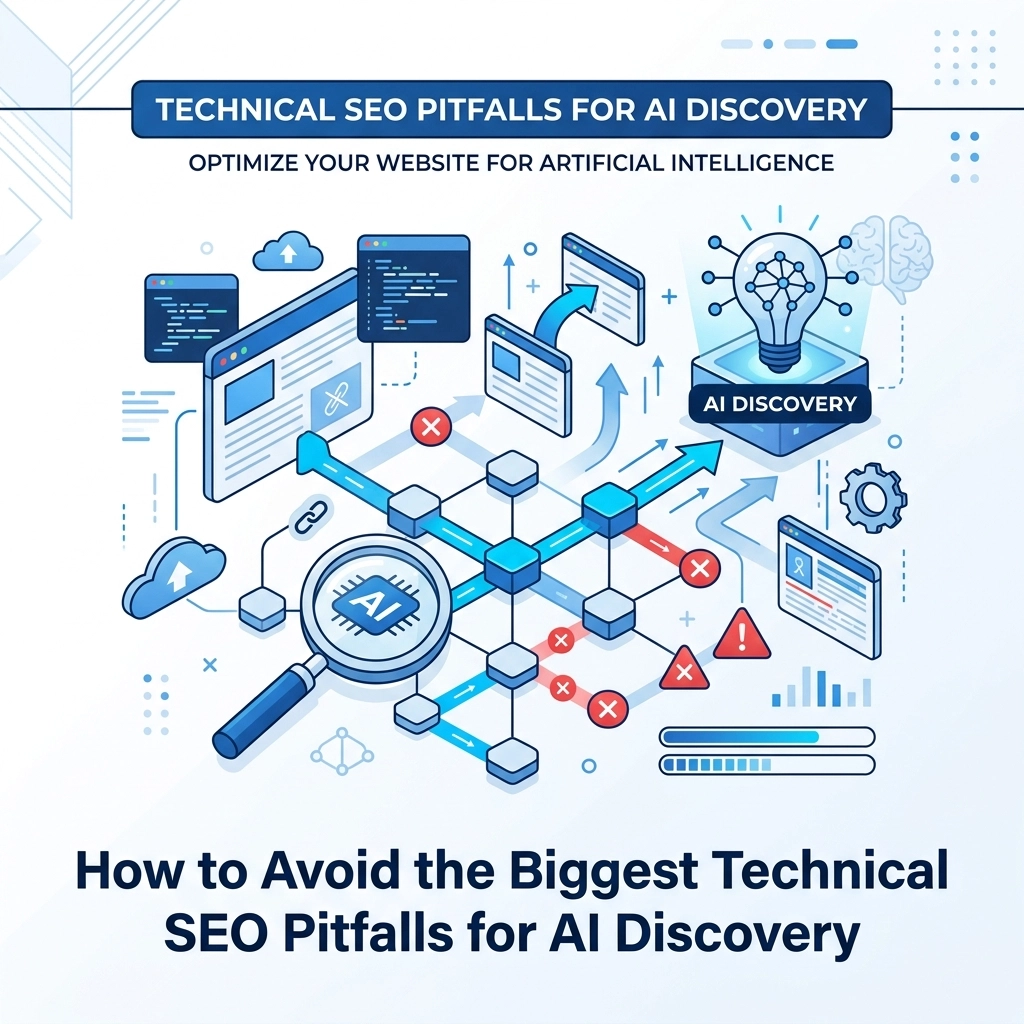

Search is changing faster than ever before because of Artificial Intelligence. Traditional search engines like Google are evolving into Answer Engines, and new players like Perplexity and ChatGPT are becoming the first stop for users seeking information. If your website is technically flawed, these AI models will struggle to find, read, or cite your content. This shift means that technical SEO is no longer just about ranking in a list of links. It is about becoming the primary source of truth for an AI response. Many businesses make simple mistakes that prevent AI discovery entirely. We have identified the biggest technical pitfalls and provided the steps you need to take to fix them
The JavaScript Ghost Town
Many modern websites rely heavily on JavaScript to load content. While this creates a smooth user experience, it often creates a "ghost town" for AI crawlers. If your content only renders on the client side, a bot might see a blank page or a loading spinner instead of your valuable information. AI crawlers are often more impatient than standard search bots. They need to parse data quickly to build their large language models. If your site requires a browser to execute complex scripts before the text appears, you are likely being ignored by AI discovery tools
How to Fix Rendering Issues
You should implement Server-Side Rendering (SSR) or Static Site Generation (SSG) for your most important pages. This ensures that the HTML sent to the crawler already contains the full text of your article or product description. You can verify what a bot sees by using a "View Source" check on your browser. If you find the main body of your text is missing from the source code, you have a problem. Moving to a more crawler-friendly rendering method is a core part of a modern marketing strategy

Locking the Door on AI Crawlers
A common mistake is found when webmasters accidentally block AI bots in the robots.txt file. This file tells crawlers which parts of your site they can visit. Over the last year, many companies have started blocking "GPTBot" or "CCBot" because of privacy concerns or to prevent data scraping. However, if you block these bots, your website will not be cited as a source in AI-generated answers. This is a massive pitfall for SEO marketing because you are essentially opting out of the future of search
How to Audit Your Robots.txt
Open your website's robots.txt file by adding /robots.txt to your domain. Look for "Disallow" commands followed by AI-related user agents. We suggest you only block AI bots from your sensitive data or private folders. Keep your informational content, blog posts, and service pages open for discovery. If you want your brand to appear in AI recommendations, the bots must be allowed to crawl your public-facing pages. You can learn more about how we handle these technical foundations on our strategy page
Thinking Structured Data is Optional
Structured data, or Schema markup, has always been important for SEO. In the age of AI discovery, it is absolutely essential. AI models use Schema to understand the context of your content without having to guess. If you have a recipe page without Schema, the AI might figure out it is a recipe, but it might hallucinate the cooking time or ingredients. With Organization, Article, and FAQ Schema, you provide a clear roadmap that the AI can follow with 100% accuracy
Implementing Semantic Markup
You should prioritize Organization, Article, and BreadcrumbList schema on every page. These are the most common types found on pages cited by AI search engines. Use the FAQ schema to directly answer common questions in your industry. This increases the chances of your site being pulled into a "Quick Answer" box or an AI summary. We found that sites with robust Schema have a much higher citation rate in conversational search results. If your site lacks this structure, our web design team can help integrate it properly

Neglecting Your XML Sitemaps
A sitemap is like a table of contents for your website. If your sitemap is outdated or contains broken links, AI crawlers will have a hard time discovering your new content. AI discovery depends on speed. When you publish a new insight or a product, you want the AI models to know about it immediately. A messy sitemap slows down this process and might lead the bot to ignore your newest and most relevant updates
Cleaning Up Your Discovery Path
Check your XML sitemap for 404 errors or redirected links. Every URL in your sitemap should lead to a live, high-quality page. You should also ensure that your sitemap is submitted to Search Console and mentioned in your robots.txt file. We suggest you set up an automated sitemap generator that updates every time you post new content. This ensures that discovery is always happening in real-time without manual intervention
Cluttered and Non-Semantic URL Structures
AI models prefer clear and descriptive URL paths. A URL like website.com/p=123 tells an AI nothing about the content. On the other hand, a URL like website.com/seo-marketing-tips provides immediate context. We found that URLs with 17 to 40 characters that use descriptive keywords receive significantly more citations in AI search. If your URL structure is a mess of numbers and random strings, the AI may view the page as less authoritative
Simplifying Your Permalinks
You should audit your URL slugs to make sure they are semantic and concise. Avoid using "stop words" like "and" or "the" in your URLs. Focus on the core keywords that describe the page content. If you need to change your URL structure, make sure you implement 301 redirects so you do not lose any existing SEO value. This is a technical detail that often requires professional support to execute correctly

Failing the Core Web Vitals Test
Page speed and user experience are major factors in how AI search engines rank sources. Google’s AI Overviews and other tools prioritize websites that provide a fast and stable experience. If your site has a high Cumulative Layout Shift (CLS) or a slow Largest Contentful Paint (LCP), you are signaling to the AI that your site is low quality. AI models want to send users to sites that load instantly and work perfectly on mobile devices
Improving Your Technical Foundation
You should use tools like PageSpeed Insights to find where your site is lagging. Common fixes include optimizing images, minifying CSS, and using a fast web hosting provider. If your site is slow, users will bounce, and AI bots will eventually stop recommending you. Prioritizing speed is one of the most effective ways to boost your conversion rate and AI visibility simultaneously
The Danger of Inconsistent Mobile Design
Most AI discovery happens on mobile devices. If your desktop site looks great but your mobile version is broken, you are missing a huge portion of the market. AI crawlers often use "mobile-first" indexing. This means they judge your entire site based on how it looks and performs on a smartphone. Inconsistent content between desktop and mobile is a massive pitfall that can lead to being dropped from AI indexes entirely
Ensuring Mobile Parity
Make sure all your text, images, and structured data are present on the mobile version of your site. Use a responsive design that adjusts seamlessly to any screen size. We suggest you test your site on multiple mobile browsers to ensure the layout remains intact. A solid mobile presence is a non-negotiable part of modern web design

Unstructured Walls of Text
AI models are excellent at reading, but they prefer content that is easy to parse. If your blog posts are just long walls of text without headings or bullets, the AI might struggle to extract the key points. This makes it less likely that your content will be used in a summarized answer. You want to make the AI's job as easy as possible by providing a clear hierarchy
Formatting for Parseability
Use H1, H2, and H3 tags to organize your ideas logically. Use bulleted lists for steps or features. We found that Q&A formatting is particularly effective for AI discovery. By asking a question in a heading and answering it directly in the first sentence of the following paragraph, you create a perfect "snippet" for an AI to use. This simple change in how you write can have a massive impact on your marketing performance
Summary of Action Items
Technical SEO for AI discovery is about removing friction. You want to make it as easy as possible for a bot to find your content, understand it, and trust it. By avoiding these pitfalls, you position your brand as a leader in the next generation of digital marketing. Here is your checklist:
- Move to Server-Side Rendering for all critical content
- Check your robots.txt to ensure AI bots are not blocked
- Add Article and FAQ Schema to every post
- Clean up your XML sitemap and remove broken links
- Shorten and clarify your URL slugs
- Optimize your Core Web Vitals for speed and stability
- Verify mobile parity across your entire site
- Use clear headings and lists to make content parseable
If you are ready to update your site for the AI era, we suggest you get started with a technical audit today. The future of search is here, and your technical foundation will determine if you are part of it or if you are left behind