
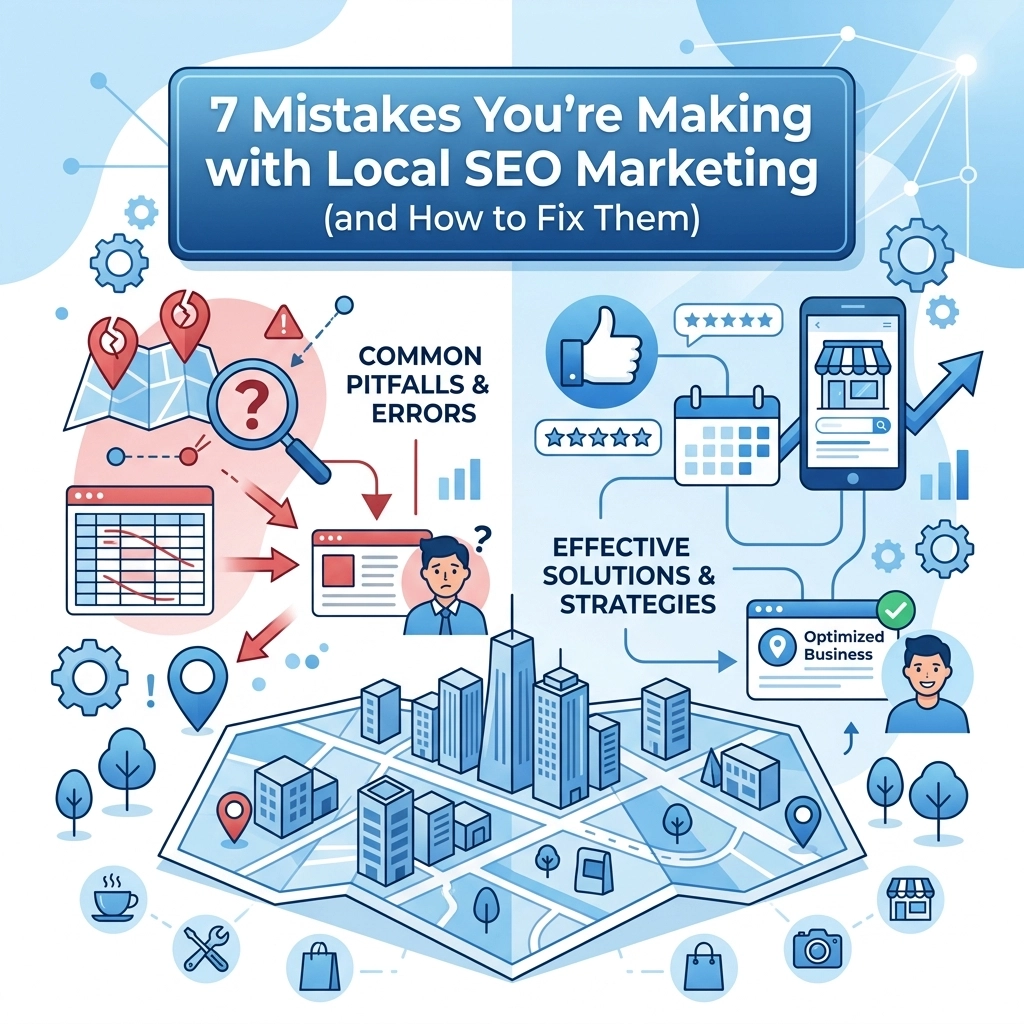

Local search visibility determines whether your neighbors find you or your competitor down the street. Many businesses treat local search engine optimization as a one-time task or a secondary priority. This mindset leads to common errors that hide your business from high-intent customers who are ready to buy. Most of these issues are technical or strategic oversights that can be corrected with minimal effort but maximum impact
1. Leaving Your Google Business Profile Incomplete
Many business owners claim their Google Business Profile and stop there. They provide a name and a phone number then assume the work is done. An incomplete profile is a signal to Google that your business might not be active or reliable. You lose ranking positions to competitors who provide more context to the search engine algorithm
The Fix
You must fill out every single field available in the dashboard. This includes your business category, services, products, and a detailed description. Upload high-quality photos of your office, your staff, and your completed work. Businesses with recent photos receive significantly more clicks and requests for directions. Use the "Posts" feature to share updates or offers directly on your profile. Keeping this information fresh shows both Google and your customers that you are open and ready for business

2. Inconsistent NAP Data Across the Web
NAP stands for Name, Address, and Phone number. Search engines use this data to verify that your business exists at a specific location. If your business is listed as "WorldWise Inc" on your website but "WorldWise Web Design" on a directory, search engines get confused. Inconsistency lowers your trust score and pushes you down the search results
The Fix
Conduct a full audit of your online presence. Check your website, social media profiles, and local directories like Yelp or the Better Business Bureau. Ensure your business name, physical address, and phone number are identical in every single place. If your address uses "Suite 100" in one place do not use "#100" in another. Use a centralized document to track every listing and update them to match your official Google Business Profile exactly. This consistency builds the digital authority necessary for high rankings
3. Ignoring Mobile Users and Page Speed
Local searches happen on the move. Most people looking for a local service are using a smartphone. If your website is slow to load or difficult to navigate on a small screen, users will leave immediately. Google prioritizes mobile-friendly sites in local search results. A slow site kills your Conversion Rate Optimization efforts before the customer even sees your offer
The Fix
Test your website using speed analysis tools to find bottlenecks. Large images are often the primary cause of slow load times. Compress every image before uploading it. Ensure your site uses responsive web design so the layout adjusts automatically to any screen size. Buttons should be large enough to tap easily and text must be legible without zooming. Fast sites provide a better user experience and signal to search engines that your business is high-quality

4. Targeting Generic Keywords instead of Local Intent
Trying to rank for broad terms like "web design" puts you in competition with every company in the world. This is a waste of your marketing budget if you primarily serve a specific region. Generic keywords lack the intent that local customers have. People looking for local help use modifiers that signify they want someone nearby
The Fix
Shift your focus to long-tail keywords that include your service area and surrounding communities. Instead of "digital marketing" target "digital marketing services for small businesses." Use natural language that mimics how people speak into voice assistants. Research what your local customers are actually typing into search bars. Include these specific phrases in your page titles, meta descriptions, and headers. This strategy attracts more relevant traffic that is actually located in your service territory
5. Missing Dedicated Service Pages
Many businesses try to list every service they offer on a single page. This makes it impossible for Google to understand which specific service is the most important for a given search query. If a customer searches for "mobile app development" but your only page is a general "About Us" section you will not rank. A lack of structure hurts your marketing strategy and confuses your visitors
The Fix
Create a unique landing page for every core service you provide. If you offer web design, SEO, and hosting, each should have its own URL. This allows you to optimize each page for specific keywords related to that service. It also gives you more space to explain your expertise and provide social proof like testimonials. Detailed service pages help search engines index your site more accurately and improve your chances of appearing in the "Map Pack" for specific queries

6. Using Duplicate Content for Multiple Locations
If you serve multiple areas you might be tempted to copy and paste the same content for each location page and just change the name of the area. Google identifies this as duplicate content and may penalize your site. It also feels impersonal to the customer. They want to know you actually work in their community, not that you just generated a landing page for them
The Fix
Write unique content for every location page you publish. Mention specific landmarks, community events, or local challenges that your business addresses. Include reviews and photos from customers in that specific area. This proves your local relevance to both search engines and human readers. If you cannot write unique content for every page, it is better to have fewer, higher-quality pages than a hundred generic ones. Authentic local content is the foundation of successful SEO marketing
7. Neglecting Customer Reviews and Citations
Reviews are a major ranking factor in local search. A business with zero reviews or a low rating will struggle to appear in the top results. Many businesses fail to ask for reviews or, worse, they ignore the ones they receive. Similarly, failing to build "citations" on local business directories limits your reach and authority
The Fix
Implement a system to ask every satisfied customer for a review. Make it easy for them by sending a direct link to your Google Business Profile after a project is finished. You must respond to every review you receive whether it is positive or negative. Professional responses show that you value customer feedback. For citations, ensure you are listed in industry-specific directories and local chamber of commerce sites. These links act as "votes of confidence" for your business's location and credibility

Summary of Action Items
Local SEO is not about luck. It is about providing the most accurate and relevant information to the search engine. By fixing these common mistakes you position your business to capture the attention of customers right when they need you. Focus on technical accuracy, user experience, and authentic local engagement to dominate your local market
- Audit your Google Business Profile and fill in the blanks
- Synchronize your NAP data across all platforms
- Optimize your site for mobile speed and navigation
- Replace generic keywords with local intent phrases
- Build out individual pages for every service you offer
- Create unique copy for every location you serve
- Actively manage your reviews and local directory listings
