
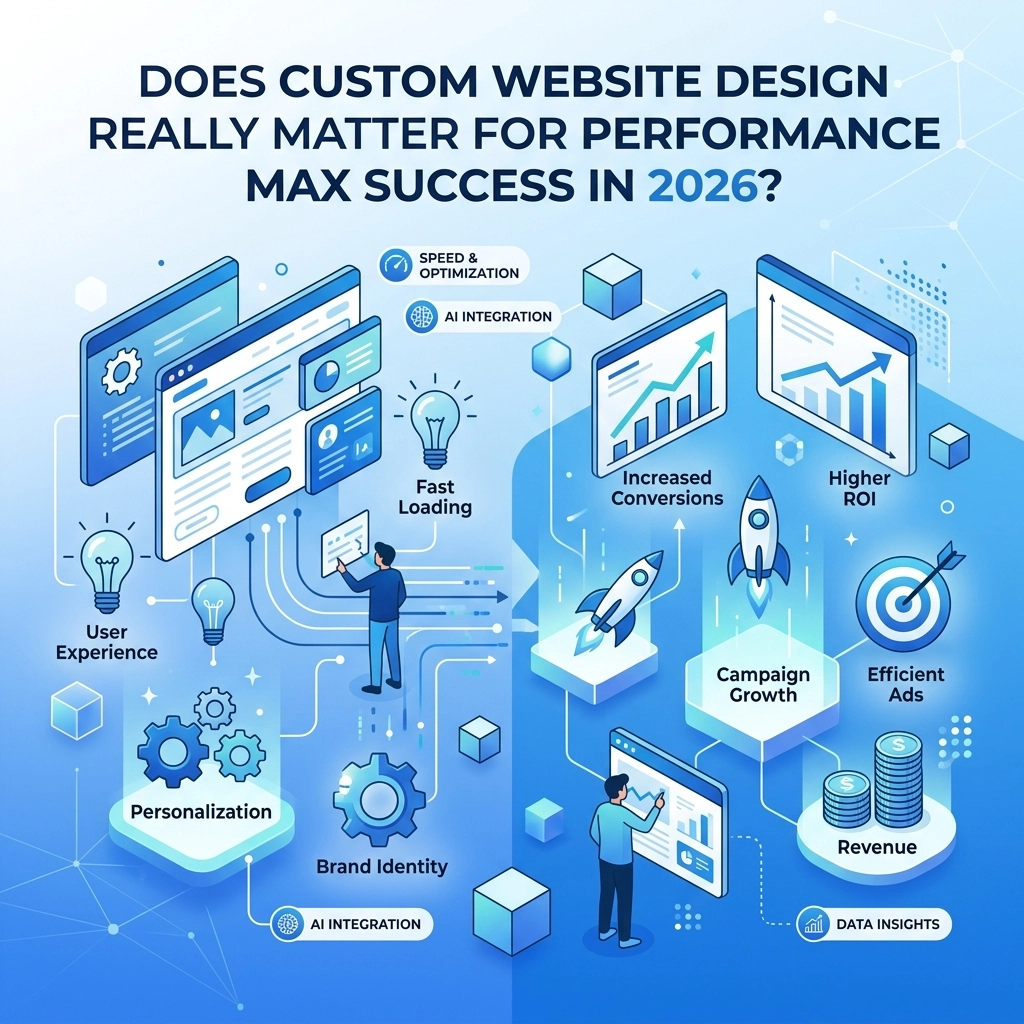

Performance Max is no longer the "new" thing in Google Ads. By 2026, it has become the standard for businesses looking to scale across Search, YouTube, Display, and Discover using a single campaign. The promise of PMax is simple: give Google your assets, set a budget, and let the AI find your customers. But there is a massive problem that many advertisers are hitting. The AI can find the right person, but it cannot fix a broken destination.
Many business owners ask if they really need a custom website design when the "algorithm is doing the heavy lifting." The short answer is yes. In fact, custom design matters more in 2026 than it did five years ago. When every competitor is using the same automated bidding strategies, your website is the only lever left to pull for a competitive advantage.
The Performance Max Paradox: Automation Needs a Solid Foundation
Performance Max relies on "signals." These signals include your audience data, your creative assets, and: most importantly: your conversion data. If your website is built on a generic, bloated template, your conversion signals will be weak.
When Google sends traffic to a page that loads slowly or looks like every other site on the web, users bounce. When users bounce, the PMax algorithm receives a signal that the traffic it found was not high quality. It then stops bidding on those high-value users, even if they were actually the perfect customers. The problem was not the ad or the audience; the problem was the landing page.
Custom website design allows you to control the narrative. Instead of forcing your brand into a pre-made box, you build an experience designed specifically to trigger the actions you want. This creates a feedback loop of high-quality data that makes your marketing strategy more effective over time.
Speed as a Revenue Metric
In 2026, speed is no longer just a technical checkbox. It is a direct driver of revenue. Recent data shows that mobile users expect a site to load in under two seconds. If it takes three seconds, over half of them are gone.
Generic templates are often filled with "bloat": excess code, unused plugins, and heavy CSS files that slow everything down. Custom-coded websites are lean. At WorldWise, we focus on web and mobile development that prioritizes performance-first design.
When your site loads instantly, you lower your bounce rate. Lower bounce rates lead to higher conversion rates. Higher conversion rates provide PMax with the volume of data it needs to optimize its bidding. If you are spending thousands on Google Ads, a slow website is effectively a tax on your advertising budget.

Conversion Rate Optimization (CRO) and the PMax Asset Group
Performance Max uses "Asset Groups." These are combinations of headlines, descriptions, and images that Google mixes and matches. However, the most important asset in that group is the Final URL.
A custom design allows for true Conversion Rate Optimization. You can place your calls-to-action (CTAs) exactly where they need to be based on heatmaps and user behavior data. Templates often have rigid headers and footers that make it difficult to implement high-converting layouts.
In 2026, users are sophisticated. They can spot a "templated" site from a mile away. A custom design builds immediate trust. It tells the customer that you are a legitimate, professional business. This trust is the difference between a click and a lead. If you want to see how we handle these high-performance builds, check out our portfolio to see custom work in action.
Mobile-First is the Only Way Forward
Most Performance Max traffic now comes from mobile devices, specifically through YouTube Shorts and the Discovery feed. A website that "works" on mobile is no longer enough. It must be designed for the thumb.
Custom design enables "thumb-friendly" navigation and vertical content flows that feel natural to a mobile user. If your site feels clunky on a smartphone, you are wasting your PMax spend. We suggest looking at your current mobile experience. Is the contact form easy to fill out with one hand? Is the font size legible without zooming? If not, you have a design problem that is costing you money.

AI Personalization and Dynamic Content
One of the biggest shifts in 2026 is the use of AI to personalize the web experience. Custom websites allow for better integration of dynamic content. For example, if PMax sends a user to your site based on a specific keyword, a custom site can dynamically swap out headlines or images to match that user's intent.
Templates are static. They treat every visitor the same. By using a custom approach to digital marketing, you can ensure that the landing page experience is a seamless continuation of the ad the user clicked. This consistency is vital for maintaining a high Quality Score and keeping your Cost Per Click (CPC) low.
Accessibility and WCAG 2.2 Compliance
Accessibility is often overlooked in the design process, but it plays a huge role in SEO and user experience. The latest WCAG 2.2 standards are strict. Many generic templates fail these standards out of the box.
A custom design ensures that your site is accessible to everyone, regardless of how they interact with the web. Google’s algorithms favor sites that are inclusive and easy to navigate. By ignoring accessibility, you aren't just losing potential customers; you are likely hurting your organic search engine optimization and PMax performance scores.
Clean Tracking and Better Data Signals
Performance Max is a "black box." You don't get to see all the data Google sees. Because of this, the data you do control must be perfect.
Custom websites allow for "cleaner" tracking. When we build a site, we ensure that every button click, form submission, and scroll event is tracked accurately via Google Tag Manager. Templates often have "ghost" code or conflicting scripts that can lead to double-counting conversions or missing them entirely. If your tracking is off by even 10%, the PMax AI will make the wrong decisions about where to spend your money.

Why Choosing "Cheap" is Expensive
It is tempting to go with a cheap, template-based site to save on upfront costs. However, when you factor in the wasted ad spend from low conversion rates and high bounce rates, the template often ends up being more expensive in the long run.
Think of your website as the storefront for your digital advertising. You wouldn't spend $5,000 a month to drive people to a store with a locked door and no lights on. A custom web design ensures that when Google’s AI brings a customer to your door, the experience is so good they can't help but buy.
The Action Plan for 2026
If you are running Performance Max and seeing plateaued results, the problem might not be your campaign settings. It is likely your website. Here is how we suggest you move forward:
- Audit your load speed. Use tools like PageSpeed Insights. If you aren't in the green, you are losing money.
- Check your mobile UX. Open your site on your phone and try to complete a purchase or fill out a form. If it’s frustrating for you, it’s frustrating for your customers.
- Analyze your conversion tracking. Ensure that your "signals" are accurate.
- Invest in custom design. Move away from the "template look" and build a site that reflects your brand's unique value.
At WorldWise, we specialize in building the high-performance foundations that digital marketing needs to succeed. Whether you need a full redesign or a strategic optimization of your current assets, we are here to help.
If you are ready to stop wasting your ad budget on a sub-par website, get started with us today or contact our team for a consultation. Let’s make sure your website is an asset, not a liability.