
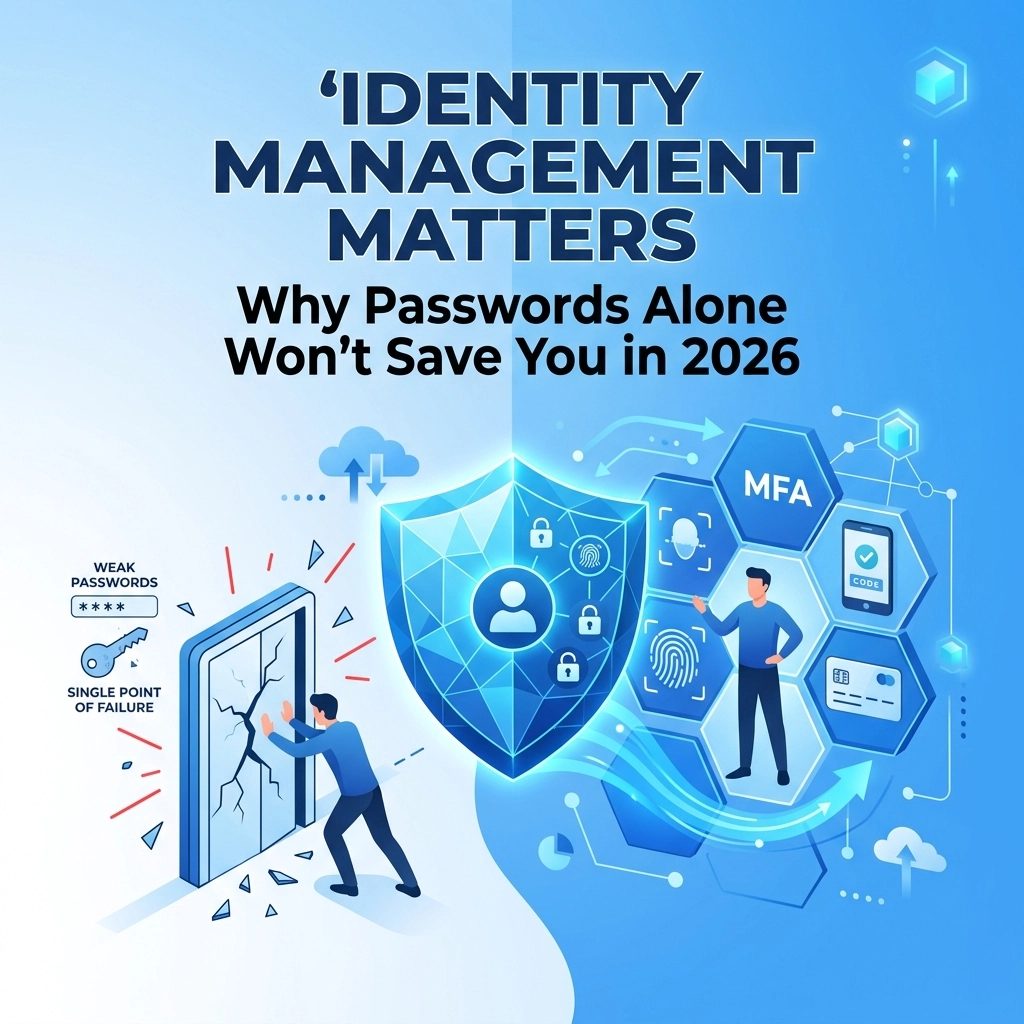

The traditional password is a relic of a simpler digital age. In 2026, relying on a string of characters to protect your business assets is a significant risk. Attackers no longer focus on "breaking in" to systems through complex coding exploits. They simply log in using stolen or intercepted credentials. This shift in tactics has made identity management the most critical part of your security strategy
We have moved past the era where a strong password was enough. Today, your digital identity is the primary target for cybercriminals. If they control your identity, they control your data, your finances, and your reputation. You need a modern approach to identity management to stay safe in the current landscape
The problem with passwords in 2026
Passwords are inherently flawed because they rely on human memory and static data. Most users choose passwords that are easy to remember, which makes them easy to guess or crack. Even complex passwords fail when they are reused across multiple sites. When one site suffers a data breach, every other account using that password becomes vulnerable
Phishing attacks have also become more sophisticated. In 2026, AI-driven phishing campaigns can mirror legitimate login pages perfectly. They trick even tech-savvy users into handing over their credentials in real-time. Once an attacker has your password, they have an open door to your business. This is why passwords alone are no longer a viable defense

Identity is your new security perimeter
The traditional idea of a "network perimeter" is dead. In the past, businesses protected their data by building a digital wall around their office. As long as you were inside the building, you were safe. Today, your employees work from home, from coffee shops, and on mobile devices. Your data lives in the cloud and across various third-party platforms
Because the wall is gone, identity has become the new perimeter. It does not matter where a user is located or what device they are using. What matters is who they are and what they are allowed to access. Identity management ensures that only the right people have the right access to the right resources at the right time. This is a core component of a Zero Trust strategy
If you want to learn more about how to structure your business for this environment, look at our strategy services for a modern roadmap
The hidden threat of non-human identities
Most people think of identity as a username for a person. In 2026, human users are actually the minority. Your business likely uses hundreds of non-human identities (NHIs). These include service accounts, API tokens, software bots, and AI agents. These entities need to talk to each other to keep your website and internal tools running
The problem is that these machine identities often have high-level permissions but very little oversight. They rarely use multi-factor authentication. If an attacker steals an API key or a service account token, they can move through your systems undetected for months. Managing these non-human identities is a massive challenge that traditional password managers cannot handle

Why standard MFA is failing
Multi-factor authentication (MFA) was supposed to be the solution to the password problem. For a long time, it worked well. However, attackers have found ways to bypass standard MFA methods. SMS-based codes are easily intercepted through SIM swapping. Push notification fatigue leads users to click "approve" on login requests they did not initiate just to make the pop-up go away
In 2026, you must use phishing-resistant MFA. This means moving away from codes and push notifications toward hardware security keys or passkeys. These methods require a physical device or a biometric scan that cannot be easily spoofed by an attacker in another country. If your current security setup relies on text message codes, you are at risk
Moving to a passwordless workflow
The best way to solve the password problem is to remove the password entirely. Passwordless authentication is the standard for secure businesses in 2026. Instead of typing a secret word, users prove their identity through something they have (a smartphone or security key) and something they are (a fingerprint or facial scan)
Passkeys are a great example of this technology. They use public-key cryptography to create a secure link between your device and the service you are accessing. There is no password for a hacker to steal from a server. Even if a website is hacked, your login data remains useless to the attacker. This transition improves security and makes the login process faster for your team

Identity governance and lifecycle management
Security is not just about the login screen. It is about the entire lifecycle of an identity. Many businesses fail to remove access for employees who have left the company. These "orphan accounts" are prime targets for hackers. Effective identity management requires a strict process for onboarding and offboarding users
You must also practice the principle of least privilege. This means giving users the minimum amount of access they need to perform their jobs. A marketing manager does not need access to the server's root directory. By limiting access, you limit the damage an attacker can do if they manage to compromise a single account
For businesses hosting sensitive data, our web hosting solutions prioritize these security standards to keep your backend safe
How WorldWise helps you secure your business
Managing identities and modern security protocols can be overwhelming for a small business owner. You have to focus on running your business, not tracking API tokens and biometric updates. That is where we come in. At WorldWise, we integrate high-level security into everything we build
Whether we are developing a new site or managing your current digital presence, we prioritize identity security. We can help you implement passwordless systems and ensure your web design supports a secure user experience. Our team understands the 2026 threat landscape and knows how to build defenses that actually work

Immediate steps you should take
The threat landscape is moving fast and you cannot afford to wait. Start by auditing who has access to your systems. Remove any accounts that are no longer active. If you are still using the same password for multiple accounts, change them immediately and use a reputable password manager
Next, look into phishing-resistant MFA. Check if your current software providers support passkeys or hardware keys like Yubikeys. Making this switch is one of the most effective things you can do to prevent a data breach this year
Problem: Your team is using weak passwords that are easily phished
Solution: Transition your office to a passwordless environment using biometrics
Problem: You have no idea how many service accounts are active on your website
Solution: Perform an identity audit to map out all human and non-human entities
Stay ahead of the curve
Cyber insurance companies are now requiring better identity management before they will even offer a policy. If you cannot prove that you have secure login protocols in place, you might find yourself unprotected and uninsurable. Identity is no longer just a technical issue. It is a business survival issue
If you are worried about your current setup, we recommend checking out our computer support services for a comprehensive review of your security posture. We stay on top of the latest trends so you do not have to

Let’s secure your digital future
The world of 2026 is interconnected and fast. Your business needs to be agile, but it also needs to be locked down. Don't let a stolen password be the reason your business suffers a setback. Move toward a more secure, identity-focused model today
If you are ready to upgrade your digital strategy and secure your identity perimeter, reach out to us. You can visit our contact page or go directly to our get started page to tell us about your project. We are ready to help you navigate the complexities of modern web security and marketing
Identity management is the foundation of a professional digital presence. Make sure yours is solid before the next wave of threats arrives