
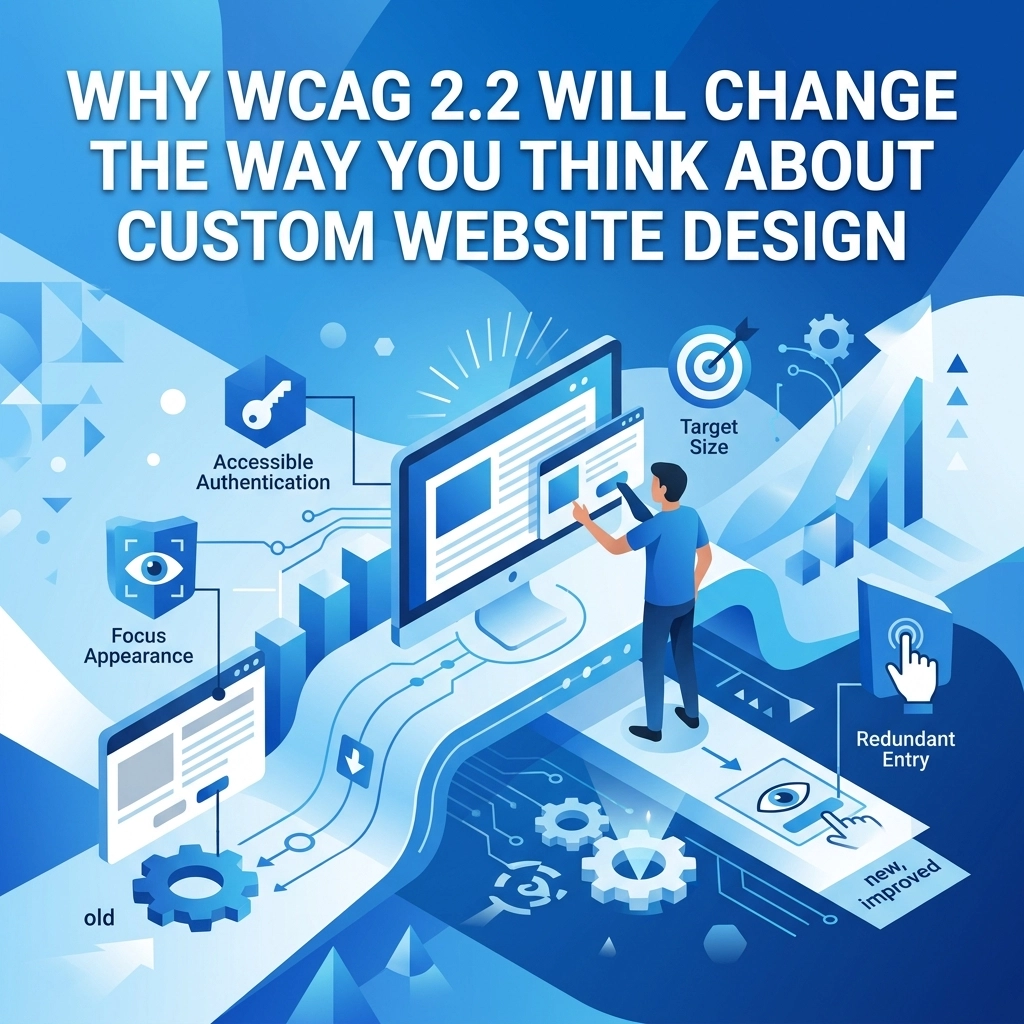

Custom website design in 2026 is no longer just about aesthetic appeal or fast loading times. The digital landscape has shifted toward a more inclusive and strictly regulated environment. The introduction and widespread adoption of the Web Content Accessibility Guidelines (WCAG) 2.2 have fundamentally changed how designers, developers, and business owners approach their online presence. At WorldWise, we see this shift as a massive opportunity to improve user experience and drive better marketing results
The End of Accessibility as an Afterthought
For years, many businesses treated accessibility as a final checklist item. It was something you looked at after the site was designed and the code was written. WCAG 2.2 changes this mindset by introducing requirements that are deeply woven into the visual and functional fabric of a site. If you wait until the end of a project to consider these standards, you are likely looking at a complete redesign rather than a simple fix
Research shows that retrofitting a website for accessibility after it has launched can cost up to 10 times more than building it correctly from the start. This financial reality is forcing companies to rethink their entire strategy. Custom design now starts with the user’s physical and cognitive needs rather than just the brand’s color palette

Focus Not Obscured: Designing for the Keyboard User
One of the most significant changes in WCAG 2.2 is the "Focus Not Obscured" criteria. This is a common problem in modern web design where sticky headers, footers, or promotional pop-ups cover up the element a user is trying to navigate to via keyboard. When a user tabs through your site, they need to see exactly where they are at all times
In the past, designers focused on keeping the navigation menu visible to help users browse. However, if that menu hides the "Submit" button on a form when a user tabs into it, the site is now non-compliant. This forces a change in how we handle sticky elements and layouts. Designers must now account for the "focus ring" in every state of the scroll. This level of detail ensures that your web design is truly functional for everyone, including those with motor impairments who rely on keyboard navigation
Dragging Movements and the End of Exclusive Gestures
Custom websites often feature interactive elements like sliders, drag-and-drop file uploads, or sortable lists. While these look great and feel modern, they can be impossible to use for individuals who cannot perform a steady dragging motion. WCAG 2.2 requires that any action involving a dragging movement must also be achievable through a simple pointer click or tap
This changes the design thinking from "How can we make this interactive?" to "How can we make this accessible to every input method?" We suggest adding "up" and "down" arrows or simple "click-to-move" functionality alongside any drag-and-drop feature. This doesn’t mean your site has to look dated. It means your custom web and mobile development must prioritize functionality across all devices and user abilities
The "Target Size" Revolution
We have all experienced the frustration of trying to click a tiny button on a mobile screen and hitting the wrong link. WCAG 2.2 addresses this by setting a minimum target size for interactive elements. Buttons and links must now have a minimum area or sufficient spacing around them to prevent accidental clicks
This requirement directly impacts the visual layout of your site. It discourages cluttered designs and forces a move toward more "breathable" interfaces. For marketing teams, this is actually a benefit. Larger, clearer buttons lead to higher conversion rates because they reduce user friction. When a call-to-action is easy to hit, the user is more likely to follow through with the desired action

Accessible Authentication: Removing the Cognitive Barrier
Perhaps one of the most important updates in WCAG 2.2 involves how users log in to your site. Many traditional security measures, such as CAPTCHAs that require you to solve a puzzle or identify images, are now considered a barrier for people with cognitive disabilities. These tasks require "cognitive function tests" that can prevent a significant portion of the population from accessing their accounts
The solution is to move toward more modern, accessible authentication methods. This includes:
- Email or SMS magic links
- Biometric authentication like FaceID or fingerprint scanning
- Automatic form filling for passwords
By implementing these, you aren't just meeting a compliance standard. You are making your site easier to use for everyone. No one likes solving a puzzle just to buy a product. Streamlining this process directly supports your lead generation and sales goals
Why Accessibility is the New SEO Strategy
In 2026, the line between SEO and accessibility has almost completely disappeared. Search engines like Google now prioritize user experience (UX) metrics more than ever. Websites that are easy to navigate, have clear structures, and provide a seamless mobile experience rank higher
When you optimize your site for WCAG 2.2, you are inadvertently optimizing for search engines. Consider these overlaps:
- Alt Text: Screen readers use it to describe images to visually impaired users; search engines use it to understand the content of your images
- Semantic HTML: Proper heading structures (H1, H2, H3) help users with assistive technology jump to the right section; they also help search bots crawl and index your page correctly
- Site Speed and Simplicity: Accessible sites tend to be lighter and faster, which is a major ranking factor in 2026
If you want to stay ahead in your digital marketing efforts, you cannot afford to ignore accessibility. A site that is invisible to a screen reader is increasingly becoming invisible to Google

Building for the AI-Driven Future
As we move deeper into 2026, more users are browsing the web using AI assistants and voice commands. These tools rely on the underlying code of your website to gather information. If your site doesn't follow WCAG 2.2 standards, these AI tools struggle to "read" your content accurately
An accessible site provides a clean, structured data source for AI agents. This means when a user asks their AI assistant to "find the best custom web design service," your site is more likely to be the one recommended if the AI can easily parse your structure and content. Accessibility is no longer just for human users: it is for the digital "users" that now mediate our online experiences
The WorldWise Approach to Inclusive Design
At WorldWise, we don't treat WCAG 2.2 as a hurdle to overcome. We treat it as a blueprint for high-performance design. Our process involves:
- Early Auditing: We identify potential accessibility gaps during the wireframe stage before any code is written
- Inclusive User Testing: We consider how different users will interact with a custom website to ensure the design is intuitive
- Technical Excellence: Our development team stays current on the latest W3C standards to ensure your site is compliant and future-proof
We believe that a professional website should be available to everyone. Whether it's through our web hosting services or our comprehensive computer support, we focus on building a digital environment that works for every user

Final Thoughts: A Design for All
The shift to WCAG 2.2 represents a maturing of the internet. We are moving away from the "wild west" of design where anything goes, toward a standard of excellence that respects the user. Thinking about accessibility forces you to be a better designer. It forces you to simplify complex ideas, prioritize the most important information, and create a more robust product
If you are ready to update your current site or start a new project that meets the highest standards of 2026, we invite you to get started with us today. Building an accessible site is not just about avoiding legal risk: it is about reaching the widest possible audience and providing the best possible experience for every person who clicks on your link
Don't wait until a compliance audit tells you your site is broken. Build it right the first time and reap the rewards of a faster, more effective, and more inclusive online presence
For more information on how we can help you navigate these changes, feel free to visit our about page or contact us directly to discuss your project needs